 Skip to main content Skip to footer


Designing a disability-friendly granny flat is about making the space safer, easier to use, and more comfortable for the person who will live there.
A disability-friendly design should not feel clinical or overly complicated. It should feel like a practical home that supports independence, movement, privacy, comfort, and everyday routines. The goal is to reduce unnecessary barriers so the occupant can use the space with more confidence.
This may be important for someone with limited mobility, a physical disability, changing health needs, or long-term accessibility requirements. It may also be useful for elderly parents, carers, family members, or anyone who wants the granny flat to remain flexible as needs change over time.
At GrannyFlow, we believe a disability-friendly granny flat should be planned from the site first. Access, layout, bathroom design, doorways, kitchen usability, storage, lighting, safety, and outdoor movement all need to work together.
Disability-Friendly Granny Flat: What It Means
A disability-friendly granny flat is designed to reduce physical and practical barriers.
This does not always mean the granny flat needs to be fully wheelchair accessible in every case. The right level of accessibility depends on the occupant’s needs, mobility, daily routine, and future requirements.
For some people, disability-friendly design may mean step-free access, wider doorways, safer bathroom features, stronger lighting, and easier movement between rooms. For others, it may require more specific planning around wheelchair access, turning space, shower access, kitchen usability, or support equipment.
This connects closely to accessible granny flats in Sydney and what makes a granny flat wheelchair accessible.
The most important point is that accessibility should be planned before the design is finalised, not added later as a fix.
Start With the Person, Not the Floor Plan
A disability-friendly granny flat should start with the person who will use the space.
Different people have different needs. A person using a wheelchair may need wider circulation and step-free access. A person with limited mobility may need safe flooring, fewer level changes, good bathroom design, and easy-to-reach storage. A person with vision challenges may need better lighting, contrast, and clear pathways.
Before choosing a design, it helps to ask:
- Who will live in the granny flat?
- What mobility needs do they have now?
- Could those needs change over time?
- Will they use a wheelchair, walker, or mobility aid?
- Will a carer need to assist them?
- Are bathroom and kitchen tasks difficult?
- Is step-free movement important?
- How much independence does the person want?
- What safety concerns need to be reduced?
These questions should guide the layout, not the other way around.
Site Access Comes First
Access to the granny flat is one of the most important parts of disability-friendly design.
The best internal layout will not work well if the occupant cannot reach the granny flat safely and comfortably. The path from the street, driveway, parking area, or main house should be reviewed early.
This connects to how important site access is during granny flat construction.
A disability-friendly access path may need:
- minimal level changes
- safe and even surfaces
- enough width for mobility aids
- good outdoor lighting
- clear route from parking or drop-off
- easy entry into the granny flat
- stable surfaces during wet weather
- handrail planning where needed
- reduced trip hazards
- safe access for carers or visitors
Access should not be treated as a late landscaping item. It is part of the main design strategy.
Step-Free Entry Where Possible
A step-free entry can make a major difference.
Steps may seem minor for some occupants, but they can become difficult or unsafe for someone using a walker, wheelchair, cane, or other mobility aid. Even one step can create a daily barrier.
A disability-friendly granny flat should consider how the occupant will move from outside to inside without unnecessary difficulty.
This may involve careful floor level planning, ramp design where suitable, gradual transitions, level thresholds, or adjusted site positioning. The best solution depends on the property and the level differences across the site.
This connects to how to future-proof a granny flat for changing mobility needs.
Step-free design is easier to plan before construction begins than to retrofit later.
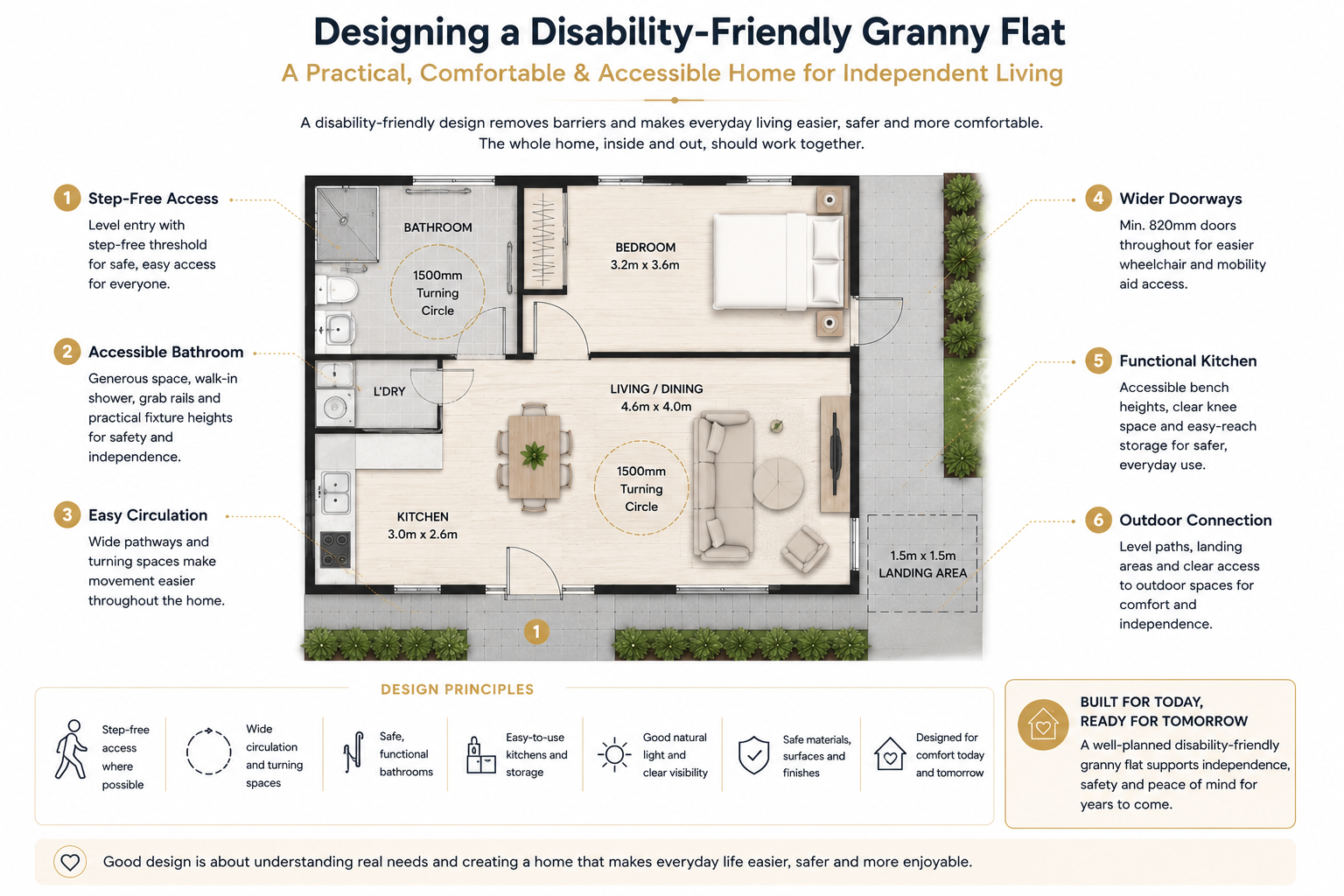
Doorways and Internal Movement
Doorways and internal circulation should be planned carefully.
A disability-friendly granny flat should allow the occupant to move between rooms without feeling squeezed or blocked. Narrow doorways, tight corners, and awkward furniture layouts can make daily life harder.
This connects to mobility-friendly granny flat design: what to prioritise.
Important movement considerations include:
- doorway width
- hallway width
- turning space where needed
- clear access to bathroom and bedroom
- enough space around furniture
- easy movement between kitchen, living, bedroom, and bathroom
- minimal internal level changes
- simple and logical room arrangement
- avoiding tight corners near doors
The layout should feel calm and easy to navigate.
A compact granny flat can still be disability-friendly if circulation is planned properly.
Bathroom Design Is Critical
The bathroom is often the most important room in a disability-friendly granny flat.
A poorly planned bathroom can make independent living difficult. A well-planned bathroom can improve safety, confidence, comfort, and daily usability.
This connects directly to accessible bathroom features to consider in a granny flat and how important bathroom design is in a granny flat.
A disability-friendly bathroom may include:
- easy shower access
- enough circulation space
- slip-resistant flooring
- good lighting
- practical vanity access
- reachable storage
- strong ventilation
- space for assistance where needed
- future grab rail planning
- simple shower controls
- easy-to-use tapware
- clear movement between toilet, vanity, and shower
The bathroom should not only meet a checklist. It should work for the person who will use it every day.
Walk-In Shower Planning
A walk-in shower is often one of the most useful accessibility features.
It can reduce the need to step over a raised hob or into a shower bath. This can make showering safer and easier for people with limited mobility.
The shower should be planned with enough space, safe flooring, drainage, ventilation, and practical controls. If assistance may be needed, the shower area should allow enough room for support.
This connects to granny flat layout ideas for safer elderly living.
A shower seat, handheld shower, grab rail allowance, and easy-to-reach controls may also be considered depending on the occupant’s needs.
Good shower planning can make the granny flat more suitable for long-term independent living.
Toilet and Vanity Access
Toilet and vanity placement should be considered carefully.
A bathroom may look good visually but still be difficult to use if the toilet is too cramped, the vanity is hard to reach, or the door swing creates awkward movement. A disability-friendly bathroom needs enough room to move safely and comfortably.
The vanity should be practical for the occupant’s height, mobility, and reach. Storage should not require excessive bending or stretching. Tapware should be easy to use.
For some occupants, support rails or future reinforcement may be useful.
The goal is to make the bathroom feel safe and simple, not crowded or difficult.
Kitchen Design for Independence
A disability-friendly granny flat kitchen should support daily independence.
The occupant should be able to prepare food, store groceries, use appliances, clean up, and move around safely. The kitchen should be designed around real movement and reach, not only appearance.
This connects to how important kitchen design is in a granny flat.
Useful kitchen considerations include:
- accessible storage
- good lighting
- safe appliance placement
- enough bench space
- easy-to-use handles
- practical sink location
- clear movement area
- slip-resistant flooring
- easy-clean finishes
- simple layout
- reachable power points
- safe cooktop and oven positioning
A disability-friendly kitchen does not need to be large. It needs to be usable.
Storage That Is Easy to Reach
Storage is important in every granny flat, but accessibility changes how storage should be planned.
High overhead cabinets, deep low cupboards, and awkward corners may be difficult for some occupants. Storage should be placed where it can be reached safely and comfortably.
This connects to how important storage is in a granny flat.
Accessible storage may include:
- drawers instead of deep cupboards
- pull-out pantry sections
- lower wardrobe rails where suitable
- reachable bathroom storage
- easy-access linen storage
- open shelving where practical
- storage near the entry
- space for mobility aids if needed
- laundry storage that does not require awkward bending
Storage should support independence rather than creating daily frustration.
Bedroom Planning
The bedroom should be comfortable, safe, and easy to move around in.
A disability-friendly bedroom may need enough space beside the bed, clear access to wardrobes, good lighting, easy switch placement, and a direct path to the bathroom. If mobility aids are used, circulation around the bed becomes especially important.
This connects to elderly living granny flat layout ideas.
The bedroom should feel calm and uncluttered.
Furniture placement should be considered during design, not after construction. Doors, wardrobes, windows, outlets, and lighting all affect how well the bedroom works.
A good bedroom layout can make daily routines much easier.
Living Area Comfort and Movement
The living area should allow comfortable movement and clear furniture placement.
A disability-friendly living space should not feel crowded. There should be enough room to move between seating, entry points, kitchen, bathroom, and bedroom without tight turns or obstacles.
This connects to what is the best layout for a granny flat.
The living area may also need to support visitors, carers, or family members. If the occupant spends a lot of time at home, comfort, natural light, ventilation, heating, cooling, and easy access to outdoor space become even more important.
The living area should feel like a proper home, not just leftover space between rooms.
Laundry Planning
Laundry should be practical and easy to use.
In a small granny flat, laundry is often placed in a cupboard, bathroom, hallway, or kitchen-adjacent zone. For disability-friendly design, the location and usability of the laundry matter.
This connects to how to fit a practical laundry into a granny flat.
Laundry planning should consider:
- washer and dryer access
- safe bending and reach
- storage for detergents
- ventilation
- door clearance
- basket movement
- access to drying area
- clear movement around the laundry zone
If the occupant has mobility limitations, laundry should not be squeezed into a difficult corner.
Lighting for Safety
Lighting is essential in a disability-friendly granny flat.
Good lighting helps reduce trip risks, improves visibility, supports independence, and makes the space feel safer. Poor lighting can make movement more difficult, especially at night.
This connects to smart safety features for granny flats used by older residents.
Lighting should be planned for:
- entry paths
- outdoor access
- kitchen work areas
- bathroom
- bedroom
- hallway or circulation areas
- switches near entries and beds
- night-time movement
- task lighting where needed
Lighting should be practical, not only decorative.
A well-lit granny flat feels safer and easier to use.
Switches, Power Points and Controls
Switches, power points, and controls should be easy to reach.
Poorly placed outlets or switches can create daily inconvenience. For someone with limited mobility, they can become real barriers.
This connects to how important electrical planning is in a granny flat.
A disability-friendly electrical plan may consider:
- light switches near entry points
- power points at accessible heights
- outlets near beds and seating
- easy access for appliances
- heating and cooling controls
- emergency or communication devices
- external lighting controls
- internet and connectivity points
Electrical planning should reflect the person’s daily routine.
Flooring and Slip Resistance
Flooring affects safety, comfort, and movement.
A disability-friendly granny flat should avoid flooring that is slippery, uneven, difficult to roll over, or hard to maintain. Smooth transitions between rooms are important, especially if the occupant uses a mobility aid.
Flooring should be durable, easy to clean, and suitable for the intended occupant.
This connects to what level of finish should you choose for a granny flat.
The right flooring can reduce trip risks and make the granny flat easier to live in.
In wet areas, slip resistance is especially important.
Natural Light and Wellbeing
Natural light can improve comfort and daily wellbeing.
A disability-friendly granny flat should feel bright and pleasant, especially if the occupant spends a lot of time at home. Natural light can make the space feel larger, warmer, and easier to navigate.
This connects to how important natural light is in a granny flat.
However, natural light should be balanced with privacy, glare control, and heat management.
Large windows may bring in light, but they should not make the occupant feel exposed. Window placement should support both comfort and privacy.
Ventilation and Air Quality
Ventilation is important for comfort, health, and long-term maintenance.
Good airflow helps manage moisture, bathroom humidity, cooking smells, heat, and indoor air quality. This is especially important in compact dwellings where air can become stale more quickly.
This connects to how important ventilation is in a granny flat.
Ventilation should be planned in the kitchen, bathroom, laundry, bedroom, and living area.
A fresh, well-ventilated granny flat is more comfortable and easier to maintain.
Heating, Cooling and Insulation
Temperature comfort is important in a disability-friendly granny flat.
Some occupants may be more sensitive to heat or cold. Heating, cooling, insulation, window placement, orientation, shading, and ventilation all affect comfort throughout the year.
This connects to how important heating and cooling is in a granny flat and how important insulation is in a granny flat.
Comfort should be planned before construction begins.
Trying to fix heat or cold problems later may be more difficult and expensive. A well-insulated and properly ventilated granny flat is usually more comfortable and practical for long-term living.
Outdoor Space and Safe Movement
Outdoor space can improve quality of life, but it should be safe and usable.
A disability-friendly granny flat may benefit from a small courtyard, patio, garden area, or sitting space. The outdoor area should be easy to access and should not include unnecessary trip hazards.
This connects to how important outdoor space is in a granny flat.
Outdoor planning should consider:
- level or gently graded surfaces
- safe paths
- privacy
- shade
- seating areas
- lighting
- low-maintenance landscaping
- easy access from the living area
- drainage
- connection to the main house if needed
Outdoor space should support independence, not create extra difficulty.
Landscaping for Accessibility
Landscaping can make a disability-friendly granny flat more comfortable and easier to use.
Paths, planting, screens, garden beds, and outdoor surfaces should be planned around access and maintenance. Dense or high-maintenance landscaping may create problems if the occupant cannot manage it easily.
This connects to how important landscaping around a granny flat is.
Low-maintenance landscaping is often best.
It can improve privacy, soften the site, reduce glare, define paths, and make outdoor areas feel more pleasant without adding unnecessary upkeep.
Parking and Drop-Off Access
Parking and drop-off access can be important for disability-friendly living.
The occupant may need to park close to the granny flat or be dropped off near the entry. Carers, family members, support workers, or medical transport may also need practical access.
This connects to how important parking consideration is for a granny flat.
Parking and access should be planned together.
A car space that is too far away, too narrow, poorly lit, or disconnected from the entry may not support the occupant properly.
The path from parking to entry should be safe, clear, and easy to use.
Security and Peace of Mind
Security matters in a disability-friendly granny flat.
The occupant should feel safe and confident living independently. Secure doors, window locks, external lighting, clear pathways, and easy-to-use locks all help.
This connects to how important security is in a granny flat and smart safety features for granny flats used by older residents.
Security should be supportive, not intimidating.
The design should make the occupant feel comfortable while also allowing family or carers to provide support where needed.
Internet, Communication and Safety Technology
Reliable internet and communication can support independence.
The occupant may need internet for video calls, telehealth, entertainment, online services, smart devices, safety systems, or staying connected with family. Weak connectivity can reduce independence and create frustration.
This connects to how important internet and connectivity is in a granny flat.
Depending on the occupant’s needs, technology may also support reminders, alarms, emergency contact systems, smart lighting, or remote communication.
These features should be planned carefully so they are easy to use.
Carer Access and Support
A disability-friendly granny flat may need to support carers or family assistance.
If someone may help with daily tasks, the layout should allow enough room for support. This can affect bathroom size, bedroom circulation, kitchen access, entry pathways, and outdoor movement.
This connects to can a granny flat make caring for family easier.
The goal is to allow help when needed without making the occupant feel like they have lost independence.
A well-planned layout can make caring easier while still respecting privacy and dignity.
Future-Proofing for Changing Needs
Needs can change over time.
A person who is mobile today may need support later. A family member may begin using a walker, wheelchair, or other mobility aid in the future. Designing with future flexibility can reduce the need for major changes later.
This connects directly to how to future-proof a granny flat for changing mobility needs.
Future-proofing may include:
- step-free planning where possible
- wider circulation where suitable
- bathroom reinforcement for future rails
- good lighting
- simple layouts
- flexible storage
- easy access to services
- low-maintenance finishes
- safe outdoor movement
- strong heating and cooling planning
Future-proofing does not need to make the design feel medical. It simply makes the home easier to adapt.
Rental and Family Flexibility
A disability-friendly granny flat may be used by family now and another occupant later.
For example, it may be designed for an elderly parent, then later used by an adult child, carer, guest, or tenant. Accessibility features can make the dwelling more flexible for a wider range of people.
This connects to should you rent out your granny flat or use it for family.
Designing for accessibility can support long-term property flexibility.
Even if the occupant does not need every feature immediately, a more usable design can make the granny flat more practical over time.
Approval and Documentation
A disability-friendly granny flat still needs proper approval and documentation.
The project may follow CDC or DA depending on the property and design. It should also be properly certified before occupation.
Understanding CDC vs DA for granny flats helps clarify the approval pathway.
This also connects to what is an occupation certificate for a granny flat and what documents do you need before building a granny flat.
If specific accessibility requirements are needed, they should be discussed early so the design and documentation can respond properly.
Cost Considerations
Disability-friendly features can affect cost, but they can also improve long-term usability.
Some features may be simple planning decisions, such as better lighting, safer access, smarter storage, or easier circulation. Others may add cost, such as larger bathrooms, wider doorways, ramping, reinforced walls, specialist fixtures, or specific access works.
Understanding granny flat cost in Sydney helps place these decisions within the full project budget.
This connects to what affects granny flat cost the most and hidden granny flat costs homeowners often miss.
The goal is not to add every feature possible. The goal is to invest in the features that genuinely support the occupant’s needs.
Common Mistakes to Avoid
One common mistake is thinking accessibility can be added easily later.
Some features can be retrofitted, but others are much easier to plan from the beginning. Door widths, bathroom size, entry levels, circulation, and service placement can be difficult to change after construction.
Another mistake is designing around general assumptions rather than the person’s real needs.
A third mistake is focusing only on the bathroom while forgetting access, kitchen usability, storage, lighting, parking, and outdoor movement.
This connects to common mistakes when building a granny flat.
A disability-friendly design should consider the full living experience.
Why a Site Check Helps
A site check can help determine how a disability-friendly granny flat should be planned on a specific property.
It can review access, slope, parking, entry points, privacy, services, drainage, outdoor space, and the relationship between the granny flat and the main house.
If designing a disability-friendly granny flat, book a site check / consultation before choosing a layout.
A site-first approach helps make sure the design responds to both the occupant’s needs and the property’s conditions.
Final Thoughts
Designing a disability-friendly granny flat is about creating a home that is safer, more usable, and more supportive of independent living.
The most important features are usually access, circulation, bathroom usability, kitchen function, storage, lighting, flooring, heating and cooling, outdoor movement, security, and future flexibility.
A disability-friendly granny flat should still feel warm, comfortable, and personal.
When planned properly, it can support independence, family care, ageing in place, changing mobility needs, and long-term flexibility on the property.
Find Out What You Can Build on Your Land
Planning a disability-friendly, accessible or future-ready granny flat?
GrannyFlow can review your site, access, levels and likely approval pathway to help you understand what may be practical before moving into detailed design.
Find Out What You Can Build on Your Land
Explore Accessible Granny Flats in Sydney
FAQ: Disability-Friendly Granny Flats
What is a disability-friendly granny flat?
A disability-friendly granny flat is designed to reduce barriers and make daily living safer and easier. It may include step-free access, wider movement areas, safer bathroom features, good lighting, practical storage, and easier access to key rooms.
Does a disability-friendly granny flat need to be wheelchair accessible?
Not always. Some disability-friendly designs need full wheelchair access, while others focus on mobility support, safer movement, bathroom usability, and future-proofing. The design should match the occupant’s needs.
What rooms matter most in a disability-friendly granny flat?
The bathroom, kitchen, bedroom, entry, and living area are especially important. These spaces need to support safe movement, easy reach, comfort, and daily independence.
Should accessibility be planned before construction?
Yes, accessibility should be planned before construction. Features like entry levels, bathroom size, doorways, circulation, and layout are much easier to include early than retrofit later.


