 Skip to main content Skip to footer


An accessible bathroom can make a granny flat safer, easier to use, and more comfortable for everyday living.
This is especially important if the granny flat will be used by an elderly parent, someone with limited mobility, a person using a wheelchair or walker, or a family member whose needs may change over time. In a compact dwelling, the bathroom is one of the most important areas to get right because it affects independence, safety, privacy, and daily confidence.
A good accessible bathroom does not need to feel clinical. It should feel like a well-designed, practical bathroom that quietly supports easier movement, safer use, and long-term comfort.
At GrannyFlow, we believe accessible bathroom planning should happen early. Once the bathroom size, plumbing, drainage, walls, door position, and fixtures are built, changes can become more difficult and expensive.
Accessible Bathroom Granny Flat: Why It Matters
An accessible bathroom in a granny flat matters because bathrooms are high-use, high-risk spaces.
Wet floors, tight layouts, narrow doorways, awkward shower entries, poor lighting, and limited circulation can all make daily use harder. For someone with mobility needs, these details can affect whether the granny flat feels genuinely independent or difficult to live in.
This connects closely to designing a disability-friendly granny flat and how important accessibility design is in a granny flat.
The bathroom should support:
- safe entry and exit
- easy shower access
- comfortable toilet use
- practical vanity access
- good lighting
- enough circulation space
- safe flooring
- strong ventilation
- simple cleaning
- future support features if needed
The goal is to make the bathroom easier to use without making the space feel overbuilt or medical.
Start With the Person Who Will Use the Bathroom
The best accessible bathroom design starts with the occupant.
Different people need different levels of accessibility. An elderly parent may need a safer shower, better lighting, and fewer trip hazards. A wheelchair user may need more circulation space, wider doorways, and more specific fixture placement. Someone with changing mobility needs may need a bathroom that can adapt over time.
Before finalising the bathroom design, it helps to ask:
- Will the person use a wheelchair, walker, cane, or mobility aid?
- Is step-free shower access important?
- Will a carer need to assist inside the bathroom?
- Does the person need grab rails now or later?
- Is bending or reaching difficult?
- Is night-time bathroom access a concern?
- Does the bathroom need to support future mobility changes?
- How much space is needed around the toilet, vanity, and shower?
These questions should guide the design before the layout is locked in.
Bathroom Size and Circulation
Bathroom size is one of the most important accessibility decisions.
A small bathroom can still work well, but it needs enough room for safe movement. If the space is too tight, it can become difficult to enter, turn, use fixtures, dry off, or receive assistance from a carer if needed.
This connects to what makes a granny flat wheelchair accessible and mobility-friendly granny flat design: what to prioritise.
Circulation should be considered around:
- the door
- the toilet
- the vanity
- the shower
- towel rails
- storage
- any mobility aid
- any future support equipment
In a granny flat, every square metre matters. The bathroom should be compact, but not cramped.
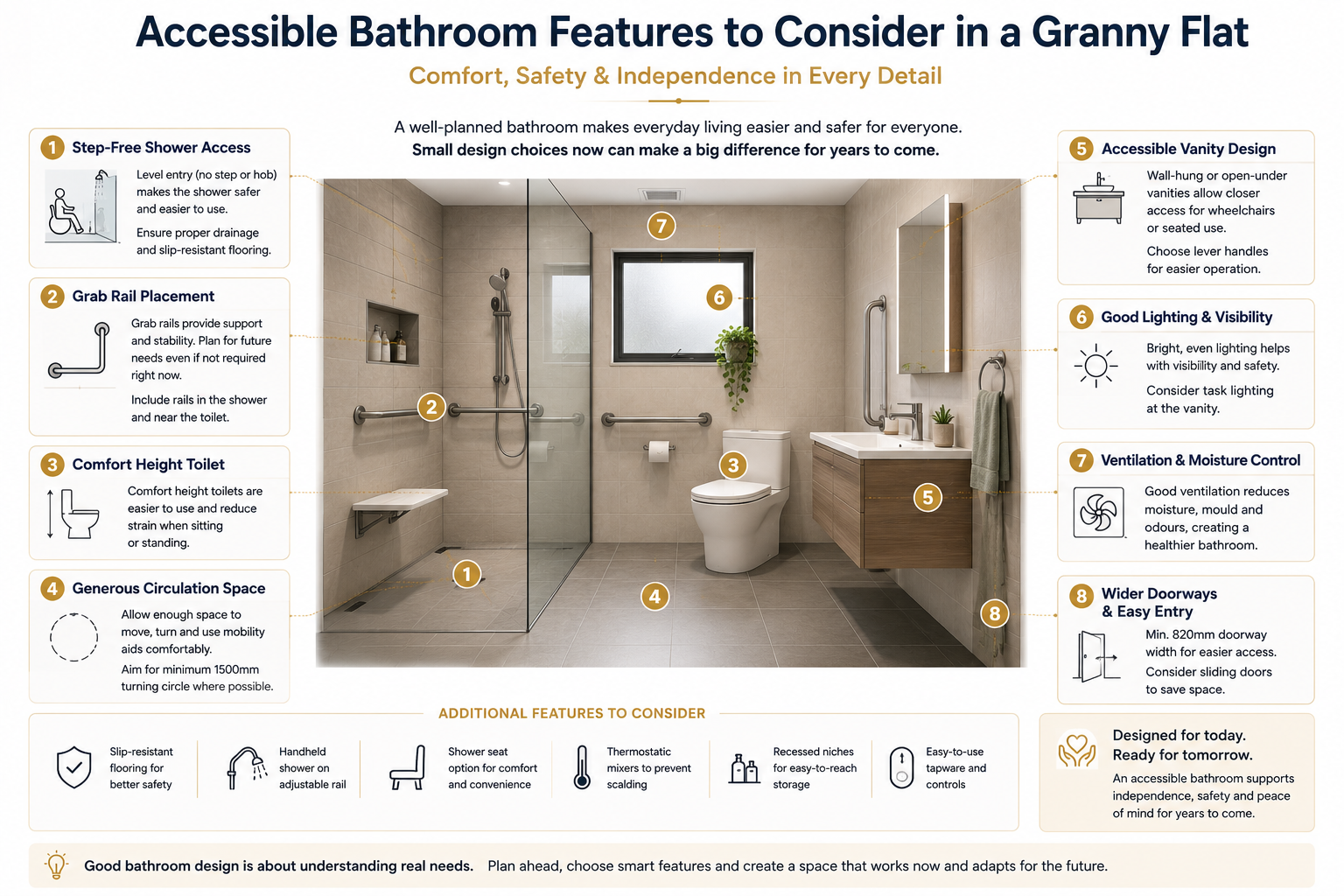
Doorway Width and Door Swing
The bathroom doorway should be easy to use.
A narrow doorway can become a major problem for someone using a walker, wheelchair, or other mobility aid. Door swing also matters because an inward-swinging door can reduce usable space inside the bathroom.
Depending on the layout, a sliding door or cavity slider may help save space and improve access. In some cases, an outward-swinging door may also make emergency access easier.
The door should be planned with real use in mind.
This includes moving in and out safely, carrying towels or personal items, and allowing assistance if needed.
A bathroom can have good fixtures, but if the entry is awkward, daily use will still be difficult.
Step-Free Shower Access
Step-free shower access is one of the most valuable accessible bathroom features.
Raised shower hobs, high thresholds, or shower-over-bath designs can create daily barriers. A walk-in shower or level-entry shower can make the bathroom safer and easier to use, especially for older residents or people with mobility limitations.
This connects to granny flat layout ideas for safer elderly living.
A step-free shower should consider:
- proper drainage
- slip-resistant flooring
- enough shower space
- easy entry
- clear glass or open access where suitable
- handheld shower option
- reachable controls
- room for a shower seat if needed
- future grab rail planning
The shower should feel safe and easy, not awkward or confined.
Shower Size and Layout
Shower size affects comfort and safety.
A small shower may technically fit, but it may not be suitable for someone who needs extra space to move, sit, or receive assistance. If a carer may help, the shower should allow enough room for that support.
A good accessible shower should be easy to enter and easy to use.
It should not require turning awkwardly, stepping over high edges, or reaching across the space to adjust water temperature.
The shower position should also work with towel access, ventilation, drainage, and privacy.
In a granny flat, the shower is often one of the most important long-term usability features.
Handheld Shower Head
A handheld shower head can make the bathroom more flexible.
It allows the occupant to shower while seated, rinse more easily, and control water direction with less movement. This can be helpful for elderly parents, people with limited mobility, or anyone who may need support in the future.
The height and position should be practical.
If the shower head is difficult to reach or adjust, it loses much of its benefit. A rail-mounted handheld shower can provide more flexibility for different users.
This is a simple feature that can improve everyday usability without making the bathroom feel clinical.
Shower Seat or Allowance for One Later
A shower seat can improve safety and comfort for some users.
Not every accessible bathroom needs a fixed seat from day one, but the design can allow for one later if needed. This is where future-proofing becomes valuable.
This connects to how to future-proof a granny flat for changing mobility needs.
A shower seat may be:
- built-in
- fold-down
- removable
- freestanding
The best option depends on the occupant’s needs and bathroom layout.
If a seat may be added later, wall reinforcement, shower size, and fixture placement should be considered early.
Grab Rails and Wall Reinforcement
Grab rails can provide important support in bathrooms.
They may be needed near the toilet, shower, or entry area, depending on the occupant’s mobility. Even if grab rails are not installed immediately, wall reinforcement can be planned during construction so rails can be added later more easily.
This is one of the strongest future-proofing decisions.
Without reinforcement, adding rails later may be more difficult or less secure.
Grab rails should be placed where they support real movement, not just where they look symmetrical. The right locations depend on the user, toilet position, shower layout, and circulation.
A good accessible bathroom should allow support features to be added without major renovation.
Slip-Resistant Flooring
Bathroom flooring should be safe under wet conditions.
Slippery flooring can create a serious risk, especially for older residents or people with mobility limitations. The flooring should provide appropriate grip while still being easy to clean and maintain.
This connects to what level of finish should you choose for a granny flat.
The flooring should also work with drainage.
If the shower is level-entry, the bathroom floor needs careful fall planning so water drains correctly without pooling where someone walks.
The right flooring helps the bathroom feel safe, practical, and durable.
Drainage and Floor Falls
Drainage is critical in an accessible bathroom.
A level-entry shower or open shower area needs the floor to drain properly. Poor drainage can cause water pooling, slippery surfaces, moisture issues, and long-term maintenance problems.
This connects to how important drainage planning is for a granny flat.
Drainage planning should consider:
- shower location
- floor falls
- bathroom size
- waterproofing
- grate placement
- water movement
- cleaning access
- long-term performance
Accessible bathrooms need careful technical planning because safety and drainage are closely connected.
A bathroom that looks accessible but drains poorly can become difficult to use.
Toilet Placement and Space
Toilet placement matters more in an accessible bathroom.
There should be enough space to approach, sit, stand, and move safely. If the toilet is squeezed between walls, vanity, or shower glass, it may be difficult for someone with mobility limitations to use.
The toilet position should also consider future grab rails or support.
This connects to how important bathroom design is in a granny flat.
For some occupants, a slightly higher toilet may be more comfortable. For others, standard height may be suitable. The right choice depends on the person’s needs.
The toilet should be practical, safe, and easy to access.
Vanity Height and Access
The vanity should be easy to use.
A vanity that is too high, too deep, or poorly positioned can make daily tasks harder. Storage underneath may also affect how close someone can stand or move to the basin.
For some users, knee clearance may be important. For others, reachable drawers and simple storage may matter more.
Useful vanity considerations include:
- easy-to-use tapware
- good lighting
- accessible storage
- clear mirror placement
- enough bench space
- rounded or softened edges where suitable
- easy cleaning
- practical power point placement
A vanity should support daily routines without requiring awkward reaching or bending.
Easy-to-Use Tapware
Tapware should be simple and comfortable to operate.
Lever-style taps are often easier to use than small twist taps, especially for people with limited hand strength, arthritis, or mobility challenges.
This applies to the basin and shower.
Shower controls should be placed where the occupant can reach them easily before stepping fully into the shower where possible. This can help avoid sudden temperature changes or awkward movement.
Small fixture decisions can make a major difference in daily independence.
Good Lighting
Lighting is essential in an accessible bathroom.
Poor lighting can increase fall risk, make grooming harder, and reduce confidence during night-time use. A bathroom should have clear, even lighting without harsh glare.
This connects to smart safety features for granny flats used by older residents.
Lighting should support:
- shower use
- vanity use
- toilet access
- night-time movement
- entry and exit
- cleaning
- mirror visibility
Switch placement also matters.
Light switches should be easy to reach from the entry, and night lighting may be useful for elderly residents or anyone who uses the bathroom during the night.
Ventilation and Moisture Control
Ventilation is very important in a granny flat bathroom.
Bathrooms are small, wet spaces. Without proper ventilation, moisture can build up and create mould, odours, dampness, and maintenance issues. This is especially important in accessible bathrooms where safety and hygiene matter.
This connects to how important ventilation is in a granny flat.
Good ventilation may include:
- an effective exhaust fan
- window ventilation where appropriate
- good airflow planning
- moisture-resistant materials
- proper waterproofing
- easy cleaning surfaces
A fresh, dry bathroom is safer, healthier, and easier to maintain.
Waterproofing and Long-Term Durability
Waterproofing is essential in any bathroom, but especially in an accessible granny flat bathroom.
A level-entry shower, larger shower area, or more open bathroom design may expose more of the floor to water. The waterproofing system needs to be planned and installed properly to protect the structure.
Poor waterproofing can lead to expensive repairs.
This connects to hidden granny flat costs homeowners often miss, because water damage can create long-term costs if the bathroom is not built correctly.
Accessible design should never compromise waterproofing.
The bathroom needs to be safe today and durable over time.
Storage That Is Safe and Reachable
Accessible bathroom storage should be easy to reach.
High cabinets, deep low cupboards, or awkward corner storage may not work well for someone with limited mobility. Storage should support daily routines, not make them harder.
This connects to how important storage is in a granny flat.
Bathroom storage may include:
- vanity drawers
- recessed shelves
- reachable medicine storage
- towel storage
- open shelving where suitable
- wall niches in the shower
- easy-access cleaning supply storage
Storage should also avoid cluttering circulation space.
A clear bathroom is safer and easier to use.
Mirror Placement
Mirror placement should suit the user.
A mirror that works for a standing adult may not work well for someone seated or shorter in height. The mirror should be positioned so the occupant can use it comfortably.
This is a small detail, but it affects daily usability.
If the bathroom may be used by different people over time, a larger mirror or carefully positioned mirror may provide more flexibility.
The goal is simple: the bathroom should support real daily use without awkward adjustments.
Towel Rails and Accessories
Towel rails, toilet roll holders, robe hooks, shelves, and accessories should be placed carefully.
If these items are too far away, too high, or positioned behind the user, they may be difficult to use. If they are placed in circulation areas, they may become obstacles.
Accessory placement should be planned around movement.
For example, towels should be reachable from the shower area. Toilet paper should be reachable from the toilet. Hooks should not interfere with doorways or mobility aids.
These small details help the bathroom feel easy and intuitive.
Emergency Access
Emergency access should be considered in accessible bathroom planning.
If someone falls or needs help, the door and layout should not make access difficult. This is one reason sliding doors or outward-opening doors may be considered in some situations.
The bathroom should not trap the occupant or make assistance harder.
This connects to can a granny flat make caring for family easier.
Emergency access is not about making the bathroom feel medical. It is about practical safety.
Families may not think about this during design, but it can become very important later.
Space for Carer Assistance
If a carer may assist the occupant, the bathroom needs enough space.
A very tight bathroom can make support difficult and uncomfortable for both people. The shower, toilet, vanity, and entry areas should be reviewed with assistance in mind.
This is especially important for elderly parents or people with changing mobility needs.
This connects to how to plan a granny flat for elderly parents.
A care-friendly bathroom does not need to be oversized, but it should not be so tight that support becomes impractical.
Planning for assistance early can protect long-term usability.
Laundry Inside or Near the Bathroom
Some granny flat layouts combine the bathroom and laundry.
This can save space, but it needs careful planning. If the bathroom is also accessible, the laundry should not reduce circulation, block access, or create obstacles.
This connects to how to fit a practical laundry into a granny flat.
Laundry planning should consider:
- washer access
- dryer access if needed
- ventilation
- storage
- safe movement
- basket handling
- door clearance
- water management
- noise
A combined bathroom-laundry can work, but only if it remains easy and safe to use.
Heating and Comfort in the Bathroom
Bathroom comfort matters, especially for older residents.
A cold bathroom can be uncomfortable and may discourage safe, calm use. Heating, ventilation, insulation, and window placement all affect comfort.
This connects to how important heating and cooling is in a granny flat and how important insulation is in a granny flat.
The bathroom should not feel cold, damp, or exposed.
Good ventilation and temperature planning help make the bathroom more comfortable and reduce moisture issues.
A comfortable bathroom supports better daily living.
Privacy in the Bathroom
Privacy is essential in any bathroom.
In a granny flat, bathroom privacy also depends on window placement, door location, external views, and the relationship between the granny flat and the main house or neighbours.
This connects to privacy ideas for granny flats on shared properties.
Bathroom windows should bring in light and ventilation where possible without creating direct views. Frosted glass, highlight windows, screening, or careful orientation can help.
Privacy should be planned alongside accessibility, not treated separately.
Accessible Bathroom Design for Rental Flexibility
An accessible bathroom can also improve future rental flexibility.
Some tenants may value easier access, step-free showers, safe flooring, and better bathroom usability. Even if the granny flat is initially built for family, accessible features can make it more practical for a wider range of future occupants.
This connects to should you rent out your granny flat or use it for family.
A well-designed accessible bathroom can support:
- elderly parents
- family members
- carers
- tenants
- guests
- future downsizing
- changing mobility needs
Accessibility can make the granny flat more adaptable over time.
Accessible Bathroom Design for Elderly Parents
If the granny flat is for elderly parents, the bathroom deserves special attention.
An elderly parent may be independent now, but future needs may change. Bathroom safety, shower access, lighting, storage, grab rail planning, and toilet placement can all help the granny flat remain useful for longer.
This connects to is a granny flat the right option for an aging parent and how to plan a granny flat for elderly parents.
The bathroom should support dignity and independence.
A parent should be able to use the space comfortably without feeling like they are living in a care facility.
Good design can make that balance possible.
Accessible Bathroom Design for Wheelchair Users
If the occupant uses a wheelchair, bathroom planning needs to be more specific.
Doorway width, turning space, shower access, toilet placement, vanity access, grab rail placement, and circulation all need careful planning. A standard compact bathroom may not provide enough space.
This connects to what makes a granny flat wheelchair accessible.
Wheelchair-friendly design should be considered from the beginning. Retrofitting a small bathroom later can be difficult and expensive.
If full wheelchair access is needed, the whole granny flat layout should support that need, not only the bathroom.
Future-Proofing the Bathroom
Future-proofing is one of the strongest reasons to plan accessibility early.
Even if the occupant does not need accessible features today, future mobility changes may make them important later. A bathroom that can adapt over time can reduce the need for major renovations.
This connects to how to future-proof a granny flat for changing mobility needs.
Future-proofing may include:
- step-free shower access
- wall reinforcement for rails
- flexible shower seat allowance
- good circulation
- safe flooring
- easy-to-use tapware
- strong lighting
- practical storage
- good ventilation
- simple maintenance
These features can make the bathroom more useful for a wider range of people.
Cost Considerations
Accessible bathroom features can affect cost, but many are easier to include during construction than later.
Some features, such as better lighting, tapware, storage placement, and shower planning, may be relatively simple design decisions. Others, such as larger circulation space, reinforced walls, level-entry showers, or specific fixtures, may affect the budget more.
Understanding granny flat cost in Sydney helps place bathroom decisions within the full project cost.
This also connects to what affects granny flat cost the most.
The goal is not to add every feature possible. The goal is to choose the features that match the occupant’s real needs and future use.
Common Accessible Bathroom Mistakes
One common mistake is making the bathroom too small.
Another is adding a step-free shower without planning drainage properly. A third is installing grab rails without considering where support is actually needed.
Other mistakes include:
- poor lighting
- slippery floor tiles
- narrow doorway
- awkward door swing
- vanity that is hard to use
- storage placed too high or too low
- no wall reinforcement for future rails
- poor ventilation
- no space for assistance
- treating accessibility as an afterthought
This connects to common mistakes when building a granny flat.
An accessible bathroom works best when safety, comfort, drainage, and daily use are planned together.
Why a Site Check Helps
A site check can help determine how the bathroom should be planned within the full granny flat layout.
It can review access, levels, drainage, services, privacy, entry position, and how the bathroom relates to the bedroom, living space, and outdoor access. These details all affect accessible bathroom design.
If planning an accessible bathroom in a granny flat, book a site check / consultation before finalising the layout.
A site-first approach helps make sure the bathroom supports the occupant and the property conditions properly.
Final Thoughts
An accessible bathroom is one of the most important parts of a disability-friendly or elderly-friendly granny flat.
The right features can improve safety, comfort, independence, and long-term usability. Step-free shower access, safe flooring, good lighting, practical circulation, easy-to-use fixtures, proper ventilation, reachable storage, and future grab rail planning can all make a major difference.
The best accessible bathrooms are not clinical. They are practical, comfortable, and thoughtfully designed.
When planned early, an accessible bathroom can help a granny flat support family care, independent living, ageing in place, rental flexibility, and changing mobility needs over time.
Find Out What You Can Build on Your Land
Planning an accessible bathroom or mobility-friendly granny flat?
GrannyFlow can review your site, access, levels and likely approval pathway to help you understand what may be practical before moving into detailed design.
Find Out What You Can Build on Your Land
Explore Accessible Granny Flats in Sydney
FAQ: Accessible Bathroom Granny Flat
What makes a granny flat bathroom accessible?
An accessible granny flat bathroom usually includes safe entry, enough circulation space, step-free shower access, slip-resistant flooring, good lighting, practical toilet and vanity placement, easy-to-use tapware, and storage that is easy to reach.
Does an accessible bathroom need a walk-in shower?
A walk-in or level-entry shower is often one of the most useful accessible bathroom features. It reduces the need to step over a raised hob and can make showering safer and easier.
Should grab rails be installed straight away?
It depends on the occupant’s needs. Even if grab rails are not installed immediately, wall reinforcement can be planned during construction so rails can be added later if needed.
Can an accessible bathroom still look modern?
Yes, an accessible bathroom can look modern, warm, and well designed. Accessibility is about practical usability, not making the space feel clinical.


