 Skip to main content Skip to footer


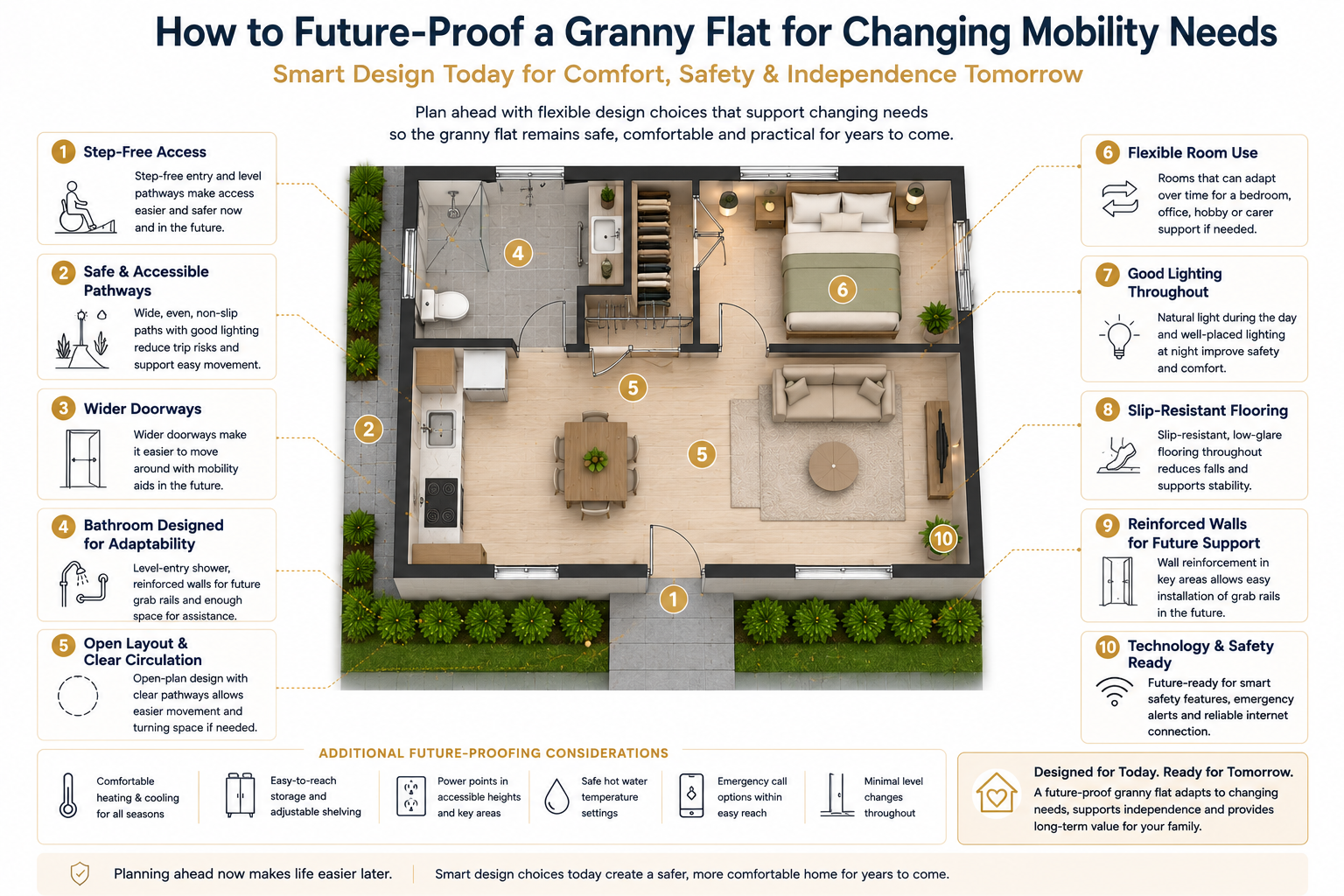
Future-proofing a granny flat means designing it so the space can remain safe, comfortable, and practical as mobility needs change over time.
This is especially important when the granny flat is being built for elderly parents, a family member with limited mobility, someone recovering from health changes, or a household that wants the dwelling to remain flexible for future use.
A granny flat may work perfectly for someone today, but needs can change. Steps that are easy now may become difficult later. A compact bathroom may feel fine today but become restrictive if a walker or wheelchair is needed. Poor lighting, tight doorways, slippery flooring, or awkward storage can become daily challenges over time.
At GrannyFlow, we believe future-proofing should be built into the design from the beginning. The goal is not to make the granny flat feel clinical. The goal is to create a warm, practical home that can adapt more easily as life changes.
Future-Proof Granny Flat: What It Means
A future-proof granny flat is designed with long-term usability in mind.
It does not only solve today’s needs. It also considers how the occupant may move, live, and use the space in the future. This can include ageing, reduced mobility, temporary injury, disability, carer support, or changing family circumstances.
Future-proofing may include:
- safer access
- fewer level changes
- wider circulation where possible
- practical bathroom planning
- better lighting
- slip-resistant flooring
- reachable storage
- flexible room layouts
- stronger heating and cooling planning
- easy outdoor movement
- future grab rail allowance
- reliable internet and safety technology
This connects closely to designing a disability-friendly granny flat and how important accessibility design is in a granny flat.
The best future-proofing decisions are usually made before construction begins.
Start With the Person’s Current and Future Needs
Future-proofing should start with the person who may use the granny flat.
An elderly parent may be fully independent now but may need more support later. An adult child may use the space now, but the granny flat may later support ageing parents or rental use. A family member may need temporary mobility support after surgery or illness.
Before finalising the design, ask:
- Who will use the granny flat first?
- Could their mobility change over time?
- Will a walker, cane, or wheelchair ever be needed?
- Will a carer need to assist inside the space?
- Is step-free access important?
- Could the granny flat be rented later?
- Could it support elderly parents in the future?
- What parts of daily life may become harder with reduced mobility?
These questions help shape a design that is useful for longer.
A future-proof granny flat should be designed around real life, not only today’s floor plan.
Site Access Should Be Planned Early
Access to the granny flat is one of the most important future-proofing decisions.
Even if the internal layout is well designed, the space may not work if the path from the street, driveway, main house, or parking area is difficult to use. A steep, narrow, uneven, or poorly lit path can become a major barrier as mobility changes.
This connects to how important site access is during granny flat construction.
Future-proof access may consider:
- smooth pathways
- fewer steps where possible
- good outdoor lighting
- safe surfaces
- enough path width
- easy movement from parking to entry
- simple access from the main house
- reduced trip hazards
- clear route for carers or visitors
- drainage that avoids slippery areas
Access should not be left as a landscaping detail. It should be part of the main planning strategy.
Step-Free Entry Where Possible
A step-free entry can make a granny flat much easier to use over time.
A single step may not seem like a major issue during construction, but it can become a daily problem for someone using a walker, wheelchair, cane, or mobility aid. It can also make it harder for carers, visitors, deliveries, or emergency access.
This connects to mobility-friendly granny flat design: what to prioritise.
Step-free entry may involve careful floor-level planning, gentle transitions, ramp planning where suitable, level thresholds, and site positioning that works with the land.
It is much easier to plan step-free access before construction begins than to retrofit it later.
A future-proof granny flat should avoid unnecessary barriers at the entry.
Wider Doorways and Better Circulation
Doorways and internal circulation strongly affect long-term usability.
A granny flat is compact, so tight spaces can quickly become difficult if mobility changes. Narrow doorways, tight corners, awkward hallway turns, and cramped room entries can reduce independence.
This connects to what makes a granny flat wheelchair accessible.
Future-proofing may include wider doorways where possible, clearer room connections, fewer tight turns, and enough circulation around key areas such as the bathroom, bedroom, kitchen, and living space.
The goal is not necessarily to make every granny flat fully wheelchair accessible unless that is required.
The goal is to avoid making the space unnecessarily difficult to use later.
Keep the Layout Simple and Logical
A simple layout is usually better for future mobility needs.
The occupant should be able to move easily between the bedroom, bathroom, kitchen, living area, entry, and outdoor space. A complicated layout can make daily life harder, especially if the person later needs support or mobility aids.
This connects to what is the best layout for a granny flat.
A future-proof layout should avoid:
- tight internal corners
- unnecessary steps
- narrow hallways
- awkward door swings
- poor bathroom access
- long routes between bedroom and bathroom
- furniture layouts that block movement
- poorly placed storage
- disconnected outdoor areas
Simple does not mean basic.
It means the granny flat should be easy to understand and easy to move through.
Bedroom Location and Movement
The bedroom should be planned for comfort, movement, and future needs.
If the occupant’s mobility changes, the bedroom needs enough space to move safely around the bed, access storage, reach lighting, and move toward the bathroom. If a walker or wheelchair may be needed later, circulation becomes even more important.
This connects to granny flat layout ideas for safer elderly living.
Bedroom planning should consider:
- bed placement
- wardrobe access
- power points near the bed
- lighting controls near the bed
- clear path to the bathroom
- enough space around furniture
- window placement for comfort and privacy
- safe flooring transitions
A bedroom should not feel like leftover space.
It should support rest, safety, and daily independence.
Bathroom Future-Proofing
The bathroom is one of the most important areas to future-proof.
A bathroom that works well today may not work later if mobility becomes limited. Tight showers, raised hobs, slippery flooring, poor lighting, inward-swinging doors, and limited circulation can all create challenges over time.
This connects directly to accessible bathroom features to consider in a granny flat.
A future-proof bathroom may include:
- step-free shower planning
- slip-resistant flooring
- good lighting
- enough circulation space
- easy-to-use tapware
- practical toilet position
- reachable storage
- strong ventilation
- future grab rail allowance
- wall reinforcement where suitable
- space for a shower seat if needed
The bathroom should feel modern and comfortable while quietly supporting long-term usability.
Wall Reinforcement for Future Grab Rails
Grab rails may not be needed immediately, but it can be smart to plan for them.
Wall reinforcement can be included during construction so grab rails can be installed later if needed. This is much easier than trying to open walls or modify the structure after the bathroom is complete.
This connects to accessible bathroom features to consider in a granny flat.
Reinforcement may be useful near:
- shower areas
- toilet
- bathroom entry
- transition points
- any area where support may be needed later
Future-proofing does not always mean installing every accessibility feature from day one.
Sometimes it means preparing the structure so those features can be added easily later.
Step-Free Shower Planning
A step-free shower is one of the strongest future-proofing features.
It reduces the need to step over a raised shower hob and can make the bathroom safer for older residents, people with mobility aids, or anyone recovering from injury.
This connects to designing a disability-friendly granny flat.
A step-free shower needs careful planning around drainage, waterproofing, floor falls, shower size, ventilation, and safe flooring.
It should not be added casually.
A poorly planned level shower can create water pooling, slippery surfaces, or maintenance issues. A well-planned one can make the bathroom much safer and more comfortable over time.
Toilet and Vanity Placement
Toilet and vanity placement should be planned for future comfort.
A toilet squeezed into a tight corner may be difficult to use if mobility changes. A vanity with awkward storage or poor reach may become frustrating. The bathroom should allow comfortable movement and easy access to key fixtures.
This connects to mobility-friendly granny flat design: what to prioritise.
Future-proofing may include:
- allowing enough space around the toilet
- considering future grab rail positions
- choosing easy-to-use tapware
- using drawers instead of deep cupboards where suitable
- placing storage at reachable heights
- ensuring mirror placement works for different users
- avoiding sharp or awkward fixture positions
Small bathroom decisions can have a major long-term effect.
Slip-Resistant Flooring
Flooring is a major safety consideration.
A future-proof granny flat should avoid flooring that becomes slippery, uneven, difficult to clean, or hard to move across with mobility aids. Smooth transitions between rooms are also important.
This connects to what level of finish should you choose for a granny flat.
Flooring should be selected for:
- safety
- durability
- easy maintenance
- comfort
- suitability for mobility aids
- moisture resistance in wet areas
- low trip risk
- long-term wear
In bathrooms, laundries, kitchens, and entries, slip resistance becomes especially important.
The right flooring can reduce risk while still looking modern and warm.
Lighting for Safety and Confidence
Good lighting helps people move confidently.
Poor lighting can increase trip risk, make bathrooms harder to use, and reduce comfort at night. A future-proof granny flat should have lighting that supports safe movement throughout the space.
This connects to smart safety features for granny flats used by older residents.
Lighting should be considered in:
- entry paths
- outdoor areas
- hallway or circulation zones
- bathroom
- kitchen
- bedroom
- living area
- laundry
- switches near beds and doors
- night-time movement areas
Lighting should feel natural and comfortable, not harsh.
A well-lit granny flat can feel safer and easier to use for people of all ages.
Switches, Power Points and Controls
Electrical planning can make a granny flat easier to use over time.
Switches, power points, air conditioning controls, internet points, appliance outlets, and lighting controls should be placed where they are practical and easy to reach.
This connects to how important electrical planning is in a granny flat.
Future-proof electrical planning may include:
- switches near room entries
- bedside controls
- enough power points to avoid extension cords
- accessible outlet heights where suitable
- outdoor lighting controls
- power for future safety devices
- internet points
- charging locations
- heating and cooling controls in practical positions
Good electrical planning reduces daily inconvenience and improves safety.
Kitchen Usability Over Time
The kitchen should support independence as needs change.
A future-proof kitchen should be easy to move around, easy to clean, and simple to use. High shelves, deep low cupboards, awkward corners, poor lighting, or difficult appliance placement can become frustrating later.
This connects to how important kitchen design is in a granny flat.
Future-proof kitchen planning may include:
- accessible storage
- easy-to-use handles
- good task lighting
- safe appliance placement
- practical bench space
- clear movement areas
- reachable power points
- easy-clean surfaces
- simple layout
- slip-resistant flooring
The kitchen does not need to be large.
It needs to support daily independence.
Storage That Remains Easy to Use
Storage should be planned for long-term usability.
A granny flat may need storage for clothing, linen, kitchen items, cleaning supplies, mobility aids, medical items, hobby items, and personal belongings. If storage is too high, too deep, or too awkward, it may become less useful over time.
This connects to how important storage is in a granny flat.
Future-proof storage may include:
- built-in wardrobes
- drawers instead of deep cupboards
- reachable shelving
- linen cupboards
- bathroom storage
- laundry storage
- entry storage
- space for mobility aids
- storage that does not block circulation
Good storage keeps the granny flat organised and easier to live in.
Laundry Planning for Future Use
Laundry can become difficult if not planned carefully.
A future-proof laundry should avoid awkward bending, tight access, poor ventilation, or blocked circulation. In a small granny flat, the laundry may be placed inside a cupboard, bathroom, hallway, or kitchen-adjacent area.
This connects to how to fit a practical laundry into a granny flat.
Laundry planning should consider:
- washer and dryer access
- ventilation
- storage for laundry items
- space for baskets
- safe flooring
- easy movement
- access to outdoor drying area if used
- noise control where needed
The laundry should not reduce bathroom or hallway accessibility.
Heating, Cooling and Insulation
A future-proof granny flat should be comfortable across different seasons.
As people age or experience health changes, temperature comfort can become more important. A space that becomes too hot in summer or too cold in winter may become harder to live in.
This connects to how important heating and cooling is in a granny flat and how important insulation is in a granny flat.
Comfort depends on:
- insulation
- window placement
- orientation
- shading
- ventilation
- heating and cooling systems
- roofing and external materials
- air movement
- energy efficiency
Heating and cooling should be planned early so the granny flat remains comfortable for long-term living.
Ventilation and Indoor Air Quality
Good ventilation supports comfort, health, and maintenance.
A future-proof granny flat should feel fresh and easy to live in. Poor ventilation can lead to moisture, odours, stale air, and maintenance issues, especially in compact spaces.
This connects to how important ventilation is in a granny flat.
Ventilation matters in:
- bathrooms
- kitchens
- laundries
- bedrooms
- living areas
- storage zones
- wet areas
Future-proofing is not only about movement. It is also about creating a healthier and more comfortable indoor environment.
Natural Light and Wellbeing
Natural light can improve the feel of the granny flat and support everyday comfort.
This is especially important for occupants who spend more time at home, such as elderly parents, people with mobility limitations, or family members needing independent living close to support.
This connects to how important natural light is in a granny flat.
Natural light should be balanced with privacy, glare control, and heat management.
The granny flat should feel bright without becoming exposed or uncomfortable.
A future-proof home should be pleasant to live in, not just technically accessible.
Outdoor Movement and Usable External Space
Outdoor space can support independence, but only if it is easy to use.
A small patio, courtyard, garden area, or sitting space can improve daily comfort. However, outdoor areas should avoid uneven surfaces, poor drainage, narrow paths, or difficult steps.
This connects to how important outdoor space is in a granny flat.
Future-proof outdoor planning may include:
- safe pathways
- level or gently graded surfaces
- good lighting
- seating areas
- privacy
- shade
- low-maintenance landscaping
- safe access from the living area
- clear route to bins or parking
- drainage that avoids slippery areas
Outdoor space should make life easier, not harder.
Landscaping That Supports Mobility
Landscaping should support safety and easy maintenance.
Dense planting, uneven pavers, steep paths, loose gravel, or high-maintenance gardens may become difficult over time. A future-proof granny flat should use landscaping to improve privacy, comfort, access, and outdoor use without creating unnecessary work.
This connects to how important landscaping around a granny flat is.
Low-maintenance landscaping can help:
- define private areas
- guide movement
- soften views
- improve outdoor comfort
- support privacy
- reduce upkeep
- make pathways clearer
Landscaping should work with access and mobility, not against it.
Parking and Drop-Off Planning
Parking and drop-off access can become more important as mobility changes.
An occupant may need to park close to the granny flat, be dropped off near the entry, receive visitors, or allow carers and support workers to access the dwelling easily.
This connects to how important parking consideration is for a granny flat.
Future-proof parking planning may include:
- practical distance from parking to entry
- safe pathway
- good lighting
- reduced steps
- clear drop-off area
- enough room for doors to open comfortably
- easy access for support workers or family
Parking should be considered with access, not as a separate issue.
Security and Safety Features
Security supports confidence and independence.
A future-proof granny flat should feel safe to enter, leave, and live in. Secure doors, window locks, outdoor lighting, clear paths, and easy-to-use locks all contribute to daily comfort.
This connects to how important security is in a granny flat and smart safety features for granny flats used by older residents.
Security features should be simple and practical.
They should protect the occupant without making the space feel restrictive. The best safety features often blend into the design quietly.
Internet and Smart Safety Technology
Reliable internet can support future mobility and care needs.
It may be used for video calls, telehealth appointments, smart lighting, safety devices, entertainment, communication, and remote support. Weak internet can limit independence and make support harder.
This connects to how important internet and connectivity is in a granny flat.
Future-proof connectivity may include:
- planned Wi-Fi coverage
- wired data connection where suitable
- smart lighting support
- emergency call options
- video communication
- security systems
- smart sensors if needed
Technology should be easy to use and appropriate for the occupant.
It should support independence, not create confusion.
Carer Access and Support
A future-proof granny flat should consider whether a carer may need to help later.
This can affect bathroom space, bedroom circulation, entry access, parking, storage, and the relationship between the granny flat and the main house.
This connects to can a granny flat make caring for family easier.
Carer-friendly planning may include:
- clear access paths
- practical bathroom space
- enough room around the bed
- easy entry
- safe outdoor lighting
- space for support equipment
- storage for care-related items
- privacy for both occupant and carer
The goal is to allow support if needed without making the granny flat feel like a care facility.
Emergency Access
Emergency access should be considered in future-proof design.
Family members or emergency services may need to reach the occupant quickly. The entry should be easy to find, safe to use, and practical for urgent situations.
This does not mean the granny flat needs to look medical.
It simply means avoiding design choices that make access difficult.
Clear pathways, lighting, simple door access, and logical layout can all help.
Emergency access is one of those details that may not matter every day, but can matter greatly when needed.
Flexibility for Different Future Uses
A future-proof granny flat should also support different uses over time.
It may be used by an elderly parent now, an adult child later, a guest in the future, or a tenant if family needs change. The more flexible the layout is, the more useful the granny flat becomes.
This connects to should you rent out your granny flat or use it for family and can a granny flat create rental income.
Future flexibility may include:
- private access
- durable finishes
- strong storage
- practical kitchen and bathroom
- good internet
- outdoor space
- low-maintenance design
- accessibility features that suit many users
A granny flat that supports changing needs usually creates stronger long-term value.
Approval and Documentation
A future-proof granny flat still needs proper approval and documentation.
The project may follow CDC or DA depending on the property and design. It should also be properly certified before occupation.
Understanding CDC vs DA for granny flats helps clarify the approval pathway.
This also connects to what is an occupation certificate for a granny flat and what documents do you need before building a granny flat.
Documentation matters because the granny flat may be used differently over time.
Proper records help support future rental, resale, insurance, maintenance, and family planning.
Cost Considerations
Future-proofing can affect cost, but many smart decisions are easier and more affordable when planned early.
Some features may be simple design choices, such as better lighting, safer access, smarter storage, and practical layout planning. Others may affect the budget more, such as wider circulation, reinforced bathroom walls, step-free entries, or larger wet areas.
Understanding granny flat cost in Sydney helps place future-proofing within the full project budget.
This connects to what affects granny flat cost the most and hidden granny flat costs homeowners often miss.
The goal is not to add every possible feature.
The goal is to choose the features that improve long-term usability, comfort, and flexibility.
Common Future-Proofing Mistakes
One common mistake is waiting until mobility needs change before thinking about accessibility.
By then, key parts of the granny flat may already be difficult to alter. Doorways, bathroom size, floor levels, drainage, and wall reinforcement are much easier to plan during construction.
Another mistake is overdesigning the space so it feels clinical when that is not needed.
A third mistake is focusing only on the bathroom while ignoring access, lighting, kitchen usability, outdoor movement, storage, and parking.
This connects to common mistakes when building a granny flat.
Future-proofing works best when it is balanced and practical.
Why a Site Check Helps
A site check helps identify how the property can support future-proof design.
It can review access, levels, slope, drainage, parking, outdoor areas, privacy, services, and the relationship between the main house and granny flat. These site details affect how easy the dwelling will be to use over time.
If planning a future-proof granny flat, Find Out What You Can Build on Your Land before finalising the layout.
A site-first approach helps create a design that supports changing mobility needs without unnecessary guesswork.
Final Thoughts
Future-proofing a granny flat is about making the space easier, safer, and more comfortable to use as needs change over time.
The most important areas are access, entry, circulation, bathroom design, flooring, lighting, kitchen usability, storage, heating and cooling, outdoor movement, parking, security, and future support needs.
A future-proof granny flat does not need to feel like a care facility.
When done well, it simply feels like a practical, comfortable, thoughtfully designed home that can adapt as life changes.
By planning these details early, homeowners can create a granny flat that supports independence, family care, ageing in place, rental flexibility, and long-term property value.
Find Out What You Can Build on Your Land
Planning a future-ready granny flat for changing mobility needs or long-term family flexibility?
GrannyFlow can review your site, access, levels and likely approval pathway to help you understand what may be practical before moving into detailed design.
Find Out What You Can Build on Your Land
Explore Accessible Granny Flats in Sydney
FAQ: Future-Proof Granny Flats
What does it mean to future-proof a granny flat?
Future-proofing a granny flat means designing it so the space can remain safe, practical, and comfortable as mobility, family needs, or living arrangements change over time.
What features help future-proof a granny flat?
Helpful features include safer access, step-free entry where possible, wider circulation, accessible bathroom planning, slip-resistant flooring, good lighting, reachable storage, practical kitchen layout, and future grab rail allowance.
Should future-proofing be planned before construction?
Yes, future-proofing should be planned before construction. Features like entry levels, bathroom size, doorway width, wall reinforcement, drainage, and circulation are much easier to include early than retrofit later.
Can a future-proof granny flat still look modern?
Yes, a future-proof granny flat can look modern, warm, and comfortable. Good future-proofing is about practical usability, not making the space feel clinical.


