 Skip to main content Skip to footer


One of the most common questions families ask when planning an accessible granny flat is whether it can still be approved under CDC in NSW.
In some cases, an accessible granny flat can be approved under CDC in NSW — but only if the site, layout and access requirements fit the relevant planning rules.
That is an important question, because approval pathway affects not only the timeline, but also how early the design needs to be resolved and how closely it must fit the site. The answer is that some accessible granny flats may be able to proceed under CDC, but it depends on the property, the layout, and the level of design response required.
At GrannyFlow, this is not treated as a generic yes-or-no issue. The right approach is to review the site, understand the household’s needs, and then assess whether a suitable accessible concept can align with the likely approval pathway.
CDC Can Be Possible, but It Depends on the Site
A complying development pathway can work well when the site and design meet the required controls.
That may be possible on some accessible granny flat projects, particularly where the block has workable side access, manageable levels, and a layout that can respond to mobility needs without pushing beyond the planning framework. In other cases, the design response needed for the household may lead to a different approval pathway.
This is why the question is not simply whether accessible design can fit under CDC in theory. The better question is whether the accessible concept required for that specific family and property can do so in practice.
Accessible Design Needs to Be Assessed as Part of the Whole Site
One of the biggest mistakes is assuming CDC eligibility based only on the internal floor plan.
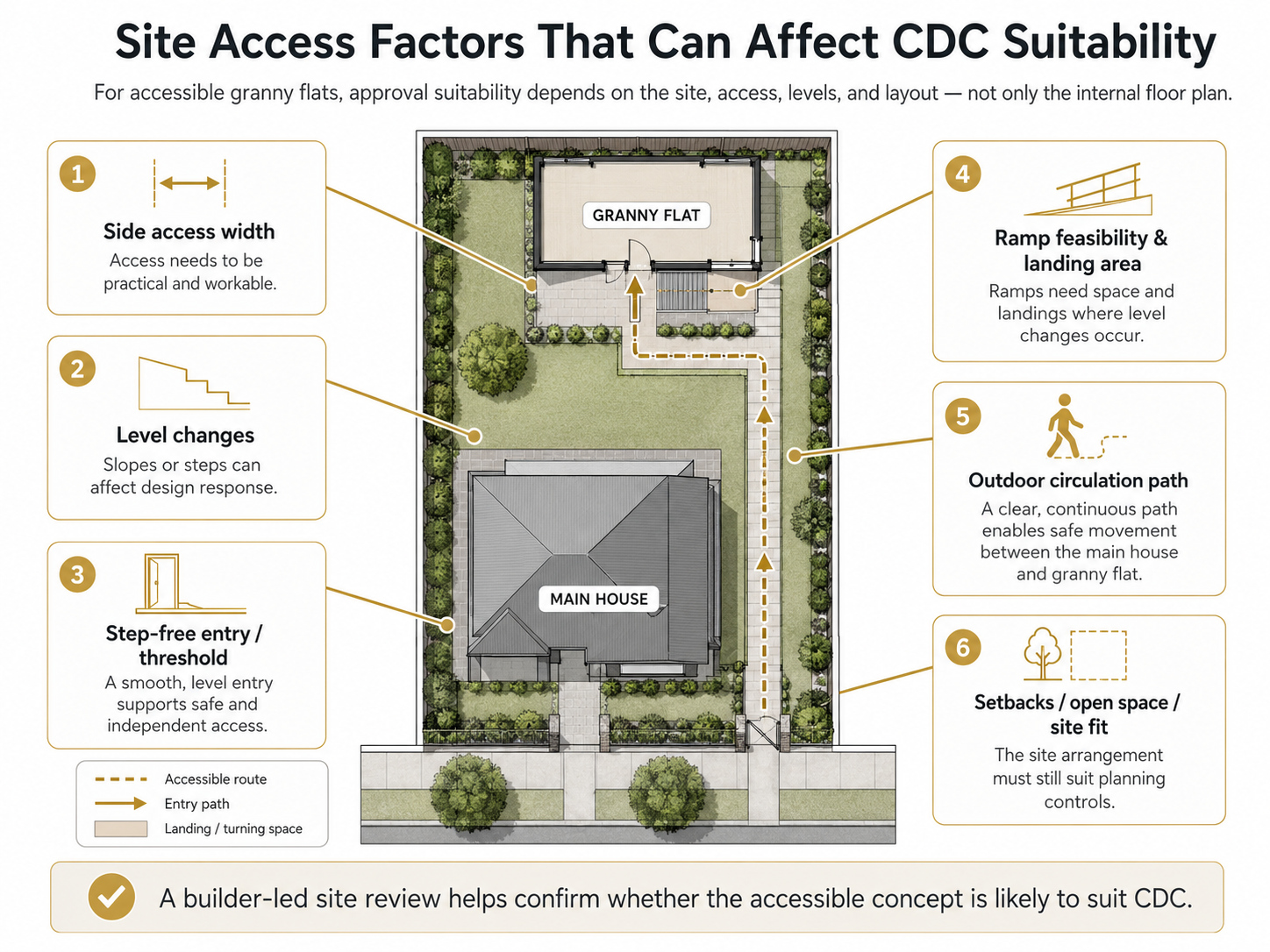
Accessible granny flat planning often involves more than room sizes or bathroom layout. It may also involve how someone moves from the main house to the backyard, whether the site allows step-free threshold options, how level changes are handled, whether ramping is practical, and how comfortable the external movement path feels in real life.
That means accessible design needs to be reviewed across the whole site, not just the interior of the granny flat. A layout may look workable on paper, but if the external access path is tight, steep, or disconnected, the overall design response may need to change.
Accessibility Does Not Stop at the Front Door
Good accessible planning is not only about wider doors or bathroom features.
It also involves site levels, step-free threshold options, ramp feasibility, landing areas, outdoor circulation, side access, and the connection between the main house and the granny flat.
This is especially important when considering CDC, because the approval pathway needs to align not only with the internal design but with how the full site arrangement works.
The Household’s Needs Come First
Accessible granny flat planning should begin with the family, not the approval pathway alone.
Some households may need a relatively simple mobility-friendly layout with easier circulation and step-free access options. Others may require a stronger response involving wheelchair-friendly movement, more adaptable bathroom design, and a more carefully planned movement path across the property.
The level of accessibility needed can influence whether the design remains straightforward enough for CDC or whether a different approval route is more appropriate.
That is why the planning process should start by understanding how the household needs to live, move, and use the space every day.
A Builder-Led Review Helps Clarify the Right Path
At GrannyFlow, the process starts with practical review rather than assumptions.
That usually means:
- understanding the household and mobility needs
- reviewing the site, access, and level changes
- developing a suitable accessible concept
- checking the likely approval pathway
- identifying whether specialist consultant input may be appropriate to the project
- providing a clearer direction on design, approvals, and quotation
This helps determine whether the accessible granny flat concept is likely to align with CDC or whether a different pathway may be more realistic.
CDC Is About Fit, Not Preference
Some families understandably prefer CDC because it may offer a more direct approval route where the project qualifies.
But the right pathway is not simply a preference. It depends on how the design fits the property and how the site supports the intended accessible outcome.
In some cases, a practical accessible design can still sit comfortably within a CDC pathway. In others, the site response, circulation requirements, or layout needs may call for a different approach.
The important thing is to align the design and approval strategy early, rather than trying to force the wrong pathway onto the project later.
Early Planning Reduces Compromise
Trying to resolve accessibility and approvals too late often creates unnecessary compromise.
If the design has already moved too far before the household’s movement needs and the site’s physical constraints are properly reviewed, the result may be redesign, delay, or a concept that does not perform as well as it should.
When accessible design is considered early alongside the likely approval pathway, the project usually becomes much easier to shape clearly and realistically.
Final Thoughts
So, can you build an accessible granny flat under CDC in NSW?
In some cases, yes — but it depends on the site, the design, and the level of accessibility required for the household. The strongest approach is to begin with practical review, understand the real movement path across the property, and then assess whether the accessible concept can align with the likely approval pathway.
That way, the design is shaped around how the family actually needs to live, not around assumptions made too early.
Find Out What You Can Build on Your Land
Planning an accessible, mobility-friendly or future-ready granny flat?
GrannyFlow can review your site, access, levels and likely approval pathway to help you understand what may be practical before moving into detailed design.
Find Out What You Can Build on Your Land
Explore Accessible Granny Flats in Sydney
General information only. CDC eligibility depends on the property, planning controls, site conditions, final design and certifier assessment.
FAQ
Can an accessible granny flat be approved under CDC in NSW?
In some cases, yes. It depends on the site, the design, and whether the accessible concept can align with the relevant planning controls.
Does accessible design make CDC approval impossible?
No. Some accessible granny flat concepts may still work under CDC, but that depends on how the layout and site conditions come together.
What site factors matter most when assessing CDC for an accessible granny flat?
Side access, level changes, outdoor circulation, step-free threshold options, ramp feasibility, and the connection between the main house and the granny flat can all influence the design response.
Should the family’s mobility needs be reviewed before deciding on CDC?
Yes. The household’s real living and movement needs should be understood first, then the site and approval pathway should be assessed around that.


