 Skip to main content Skip to footer


Many families start by looking at standard granny flat designs and then wonder whether an accessible granny flat is simply the same thing with a few added features.
In reality, the difference usually goes deeper than that.
An accessible granny flat is not just a standard layout with wider doors or a different bathroom. The stronger difference is in how the design responds to movement, site access, daily usability, and long-term comfort from the very beginning.
At GrannyFlow, the goal is not to separate accessible design from good design. It is to create granny flats that work more thoughtfully for the people who will actually live in them.
Standard Granny Flats Usually Start With a General Layout
A standard granny flat is typically designed to suit a broad range of households.
That usually means a practical layout, comfortable living areas, and a straightforward relationship between rooms. For many families, that works well. But when mobility, ageing-in-place, or wheelchair-friendly movement become part of the project, the layout often needs more careful planning.
A standard design may still form the base of the conversation, but it may not fully address how someone moves through the home, how they enter it, or how the site affects access.
Accessible Granny Flats Are Planned Around Movement
The biggest difference is often the planning approach.
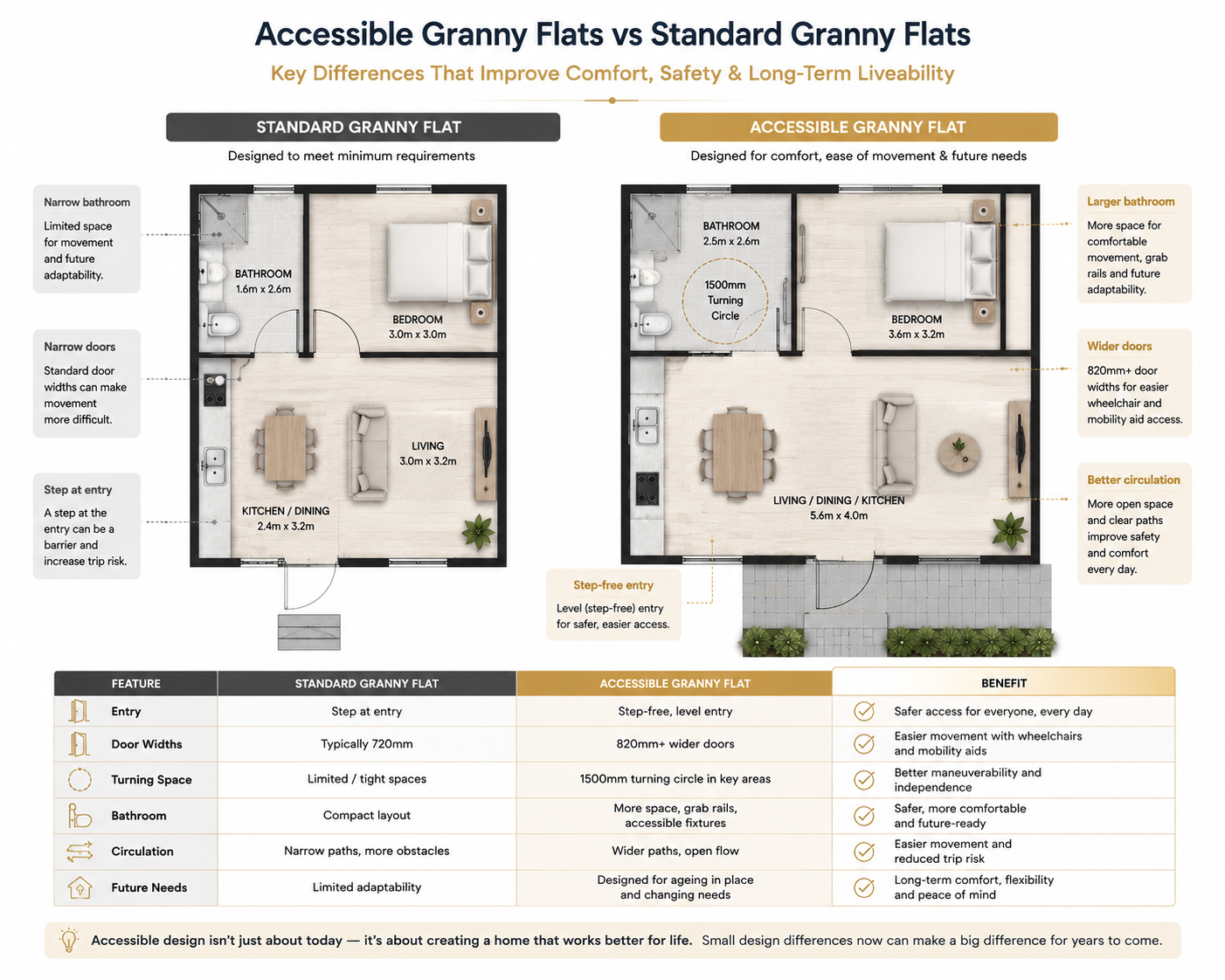
Accessible granny flats are shaped around how someone actually moves through the property and the home each day. That includes movement from the main house to the granny flat, side access, site levels, threshold design, circulation inside the home, and the practical use of bathrooms, kitchens, and living spaces.
That means accessible design is not only about adding features. It is about making different layout decisions from the beginning.
Accessibility Does Not Stop at the Front Door
A standard granny flat may focus mostly on the internal layout.
An accessible granny flat needs to consider the whole movement path across the property. If the route from the main dwelling to the granny flat is awkward, steep, narrow, or disconnected, the home may not work well even if the internal floor plan looks reasonable.
This is why accessible planning often includes:
- step-free threshold options
- side access review
- landing area considerations
- ramp feasibility where relevant
- outdoor circulation
- better connection between the main house and the granny flat
That site-wide thinking is one of the clearest differences between a standard and a more accessibility-focused design response.
Layout Decisions Tend to Be More Deliberate
In a standard granny flat, room arrangement may focus mainly on efficiency, presentation, and general livability.
In an accessible granny flat, those same decisions are usually more deliberate because the layout needs to support easier movement and everyday independence. That may affect:
- circulation paths
- turning space
- bathroom location
- kitchen usability
- entry positioning
- how comfortably someone moves between key areas
The aim is not to make the home feel specialised. It is to make it easier to use in real life.
Bathroom and Kitchen Planning Often Change
Bathrooms and kitchens are often where the practical difference becomes most noticeable.
In a standard granny flat, these spaces may be designed around general use. In an accessible granny flat, they may need stronger circulation, more considered fixture positioning, easier movement, and a layout that supports long-term independence.
That does not mean every accessible granny flat needs the same response. It means these rooms are planned more carefully around how the person using the home will actually move and function each day.
Accessible Granny Flats Often Support Ageing-in-Place and Future-Ready Living
Another important difference is long-term planning.
Standard granny flats may be designed mainly around immediate use. Accessible granny flats are more often shaped by future needs as well. That may include ageing-in-place, reduced mobility over time, or broader family planning for long-term independence.
This is why accessible design often overlaps with future-ready design. The home is not just being shaped for now. It is being shaped to remain practical later.
Standard Does Not Mean Wrong — It Means Different Priorities
It is important to note that a standard granny flat is not a lesser product.
For many families, a standard layout is exactly the right solution. The difference is that accessible granny flats respond to a different set of priorities. When mobility, ageing, or long-term usability become central to the project, the planning process needs to change with them.
That is why the question is not which option is better in general. The better question is which approach fits the household and the site more accurately.
Builder-Led Review Helps Clarify the Right Direction
At GrannyFlow, the design process begins with understanding how the space will actually be used.
That usually involves:
- understanding the household’s living and mobility needs
- reviewing the site, side access, and level changes
- considering how someone moves from the main house to the granny flat
- developing a suitable layout concept
- checking the likely approval pathway
- identifying whether consultant input may be appropriate where needed
That process helps clarify whether a more standard layout is appropriate or whether a stronger accessible design response is the better path.
Final Thoughts
Accessible granny flats and standard granny flats are not separated by one or two features. The real difference is in how the design is planned.
A standard granny flat may suit a wide range of households. An accessible granny flat is planned more specifically around movement, usability, site access, and long-term living needs.
When the household, the site, and the movement path are understood early, it becomes much easier to shape the right kind of granny flat from the beginning.
Find Out What You Can Build on Your Land
Planning an accessible, mobility-friendly or future-ready granny flat?
GrannyFlow can review your site, access, levels and likely approval pathway to help you understand what may be practical before moving into detailed design.
Find Out What You Can Build on Your Land
Explore Accessible Granny Flats in Sydney
FAQ
What is the main difference between an accessible granny flat and a standard granny flat?
The main difference is that an accessible granny flat is planned more specifically around movement, usability, and long-term comfort rather than only general layout efficiency.
Are accessible granny flats only for people with major mobility needs?
No. They can also suit ageing-in-place living, future-ready family use, and households wanting a more practical, easier-to-use design.
Can a standard granny flat be adapted later?
Sometimes, but it is usually better to consider accessibility early. Planning for it from the beginning often creates a stronger and more practical result.
Does accessible design affect the whole site, not just the inside of the granny flat?
Yes. Side access, site levels, threshold design, outdoor circulation, and the connection from the main house all play an important role.
Do I need an accessible granny flat if no one currently uses a wheelchair?
Not necessarily, but future-ready design can still be useful for ageing parents, changing mobility needs, family flexibility and easier everyday living over time.


