 Skip to main content Skip to footer


When families begin planning a granny flat for elderly parents, the layout often matters more than the size.
A good layout can support parents today while keeping the granny flat flexible for future family use.
A larger space does not automatically create a better outcome if movement feels awkward, the bathroom is difficult to use, or the connection to the main house is not practical. In most cases, the best granny flat layouts for elderly parents are the ones that feel calm, simple, safe, and easy to live in every day.
At GrannyFlow, layout planning starts with how the person will actually use the space. That includes how they move through the granny flat, how they enter it from outside, how close they should be to family support, and how the home can remain practical as needs change over time.
What Makes a Layout Work Better for Elderly Parents
The best layouts usually prioritise ease of movement and everyday comfort.
That means avoiding unnecessary complications such as tight corners, awkward circulation, poorly positioned bathrooms, or room arrangements that make the home harder to use. A strong layout should feel intuitive from the moment someone enters the granny flat.
In practical terms, that often means:
- simpler movement between key rooms
- easier bathroom access
- more direct connection between living, kitchen, and bedroom zones
- fewer unnecessary transitions
- stronger natural light and visibility
- safer indoor-outdoor access
The goal is not just to fit everything into the floor plan. It is to create a home that feels easier to live in over time.
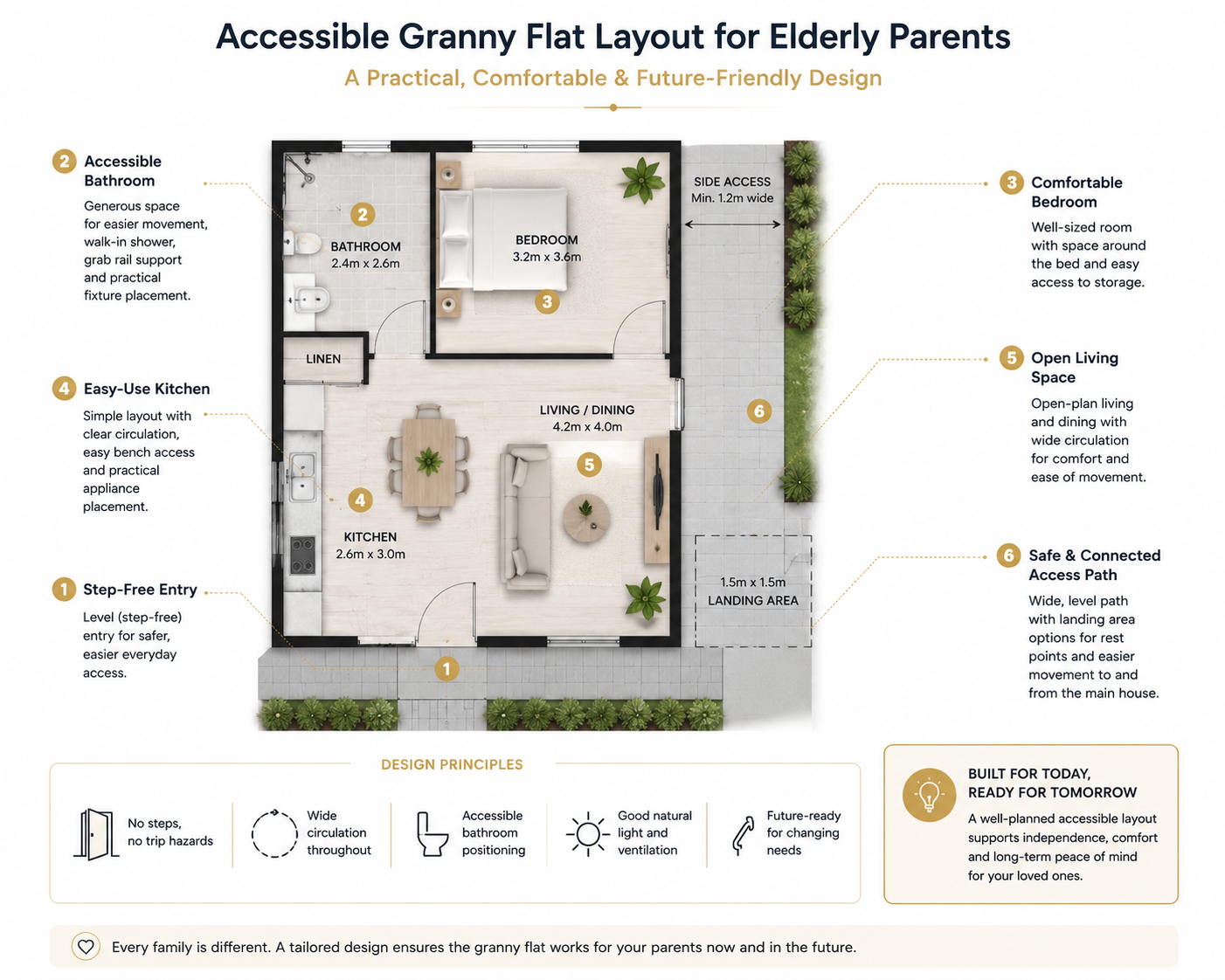
Single-Level, Easy-Flow Layouts Often Work Best
For elderly parents, layouts that feel straightforward and single-directional often perform better than ones with more fragmented room arrangements.
A simple layout can reduce confusion, improve safety, and make the space feel calmer. In many cases, a granny flat that allows someone to move from bedroom to bathroom to living area without awkward turns or narrow transitions will feel far more comfortable than a design with more complexity.
That is why simplicity is often a strength, not a compromise.
Bedroom and Bathroom Positioning Matter
One of the most important layout decisions is how the bedroom and bathroom relate to each other.
For elderly parents, that connection should feel direct and comfortable. If someone has to move too far, make multiple turns, or navigate a tighter part of the layout just to reach the bathroom, the home becomes less practical.
A strong layout usually gives the bedroom:
- clear access to the bathroom
- easy connection to the main living area
- enough privacy without feeling isolated
- comfortable movement space around the bed area
These choices can make a major difference to everyday usability.
Living Areas Should Feel Open, Not Overcomplicated
The main living zone should support comfort and independence.
That does not mean it needs to be oversized. It means it should feel easy to move through, easy to understand, and connected well to the rest of the home. Good layouts avoid unnecessary visual clutter and make transitions between living, dining, and kitchen zones feel natural.
A more open and practical living area can also help the granny flat feel less confined, especially for someone spending more time at home.
Step-Free Access and Entry Planning Are Part of the Layout
A good layout does not stop at the front door.
For elderly parents, the best granny flat layout also considers how someone gets into the dwelling in the first place. That includes the connection from the main house, side access, site levels, entry path, and whether the threshold can feel safer and easier to use over time.
This is why the most effective layouts are planned across the whole site, not only inside the building footprint.
Kitchens Should Be Easy to Use, Not Just Good to Look At
Kitchen layout matters because it affects independence every day.
For elderly parents, a kitchen should feel clear, practical, and easy to move around in. That means paying attention to bench positioning, storage reach, movement between work areas, and how naturally the kitchen connects to the living space.
In many cases, a simpler kitchen layout will perform better than one that tries to do too much in a small footprint.
The Best Layout Depends on the Household, Not a Template Alone
There is no single perfect layout for every elderly parent.
Some households may need stronger ageing-in-place considerations from the beginning. Others may only need a more future-ready plan that improves comfort and reduces barriers over time. Some parents may value privacy most, while others may benefit more from a closer connection to the main house.
That is why layout should always respond to:
- the parent’s current mobility and living needs
- the level of family support nearby
- the property’s site conditions
- the likely long-term use of the granny flat
The best layout is not the one that looks best in isolation. It is the one that works best for the people living there.
Builder-Led Planning Creates Better Outcomes
At GrannyFlow, layout planning for elderly parents starts with understanding the family and the site before locking in design decisions.
That usually means:
- understanding how the parent will use the space
- reviewing site access and movement path
- checking levels and entry conditions
- shaping a layout around daily comfort and independence
- aligning the design with the likely approval pathway
- building toward a clearer construction direction and quote
This helps create a layout that feels more specific, more practical, and more realistic from the beginning.
Final Thoughts
The best granny flat layouts for elderly parents are not simply the biggest or most feature-heavy. They are the ones that feel safer, calmer, and easier to use every day.
That usually comes down to better planning, stronger room relationships, easier bathroom and kitchen access, safer entry design, and a layout that reflects how the parent will actually live in the space.
When those things are considered early, the granny flat is far more likely to support long-term comfort, dignity, and independence.
Find Out What You Can Build on Your Land
Planning a granny flat for elderly parents, changing mobility needs or future family flexibility?
GrannyFlow can review your site, access, levels and likely approval pathway to help you understand what may be practical before moving into detailed design.
Find Out What You Can Build on Your Land
Explore Accessible Granny Flats in Sydney
FAQ
What type of granny flat layout works best for elderly parents?
Usually, a simple, easy-flow layout works best. Direct movement between the bedroom, bathroom, kitchen, and living area often makes the home more practical and comfortable.
Should the bathroom be close to the bedroom?
Yes. A direct and comfortable connection between the bedroom and bathroom is one of the most important parts of a layout for elderly parents.
Is a bigger granny flat always better for elderly parents?
Not necessarily. A well-planned smaller layout can often work better than a larger layout with awkward circulation or unnecessary complexity.
Does site access affect the layout?
Yes. Side access, levels, entry path, and the connection to the main house all influence how practical the final layout will be.


