 Skip to main content Skip to footer


When families begin planning an accessible granny flat, one of the first questions is cost.
Accessible granny flat costs depend on more than size alone. Site access, levels, layout and mobility needs can all affect the final design and construction pathway.
That is completely understandable. Accessible design often brings a different set of priorities to the project, and many homeowners want to know whether mobility-friendly planning, ageing-in-place features, or wheelchair-considered layouts will significantly increase the budget.
The honest answer is that the cost of an accessible granny flat in Sydney depends on the property, the design, and the level of accessibility being planned for. It is not simply a matter of adding a few features to a standard layout. The stronger approach is to understand how the household needs to live, how the site works, and what level of accessibility is actually required for the project.
At GrannyFlow, accessible granny flat planning starts with practical design and site review, not assumptions. That helps create a more realistic understanding of cost from the beginning.
Why Accessible Granny Flat Costs Can Vary
Not every accessible granny flat requires the same level of design response.
Some households may only need step-free access options, easier circulation, and safer bathroom planning. Others may need a more mobility-considered layout, stronger bathroom adaptability, easier outdoor access, or wheelchair-friendly movement paths between the main house and the granny flat.
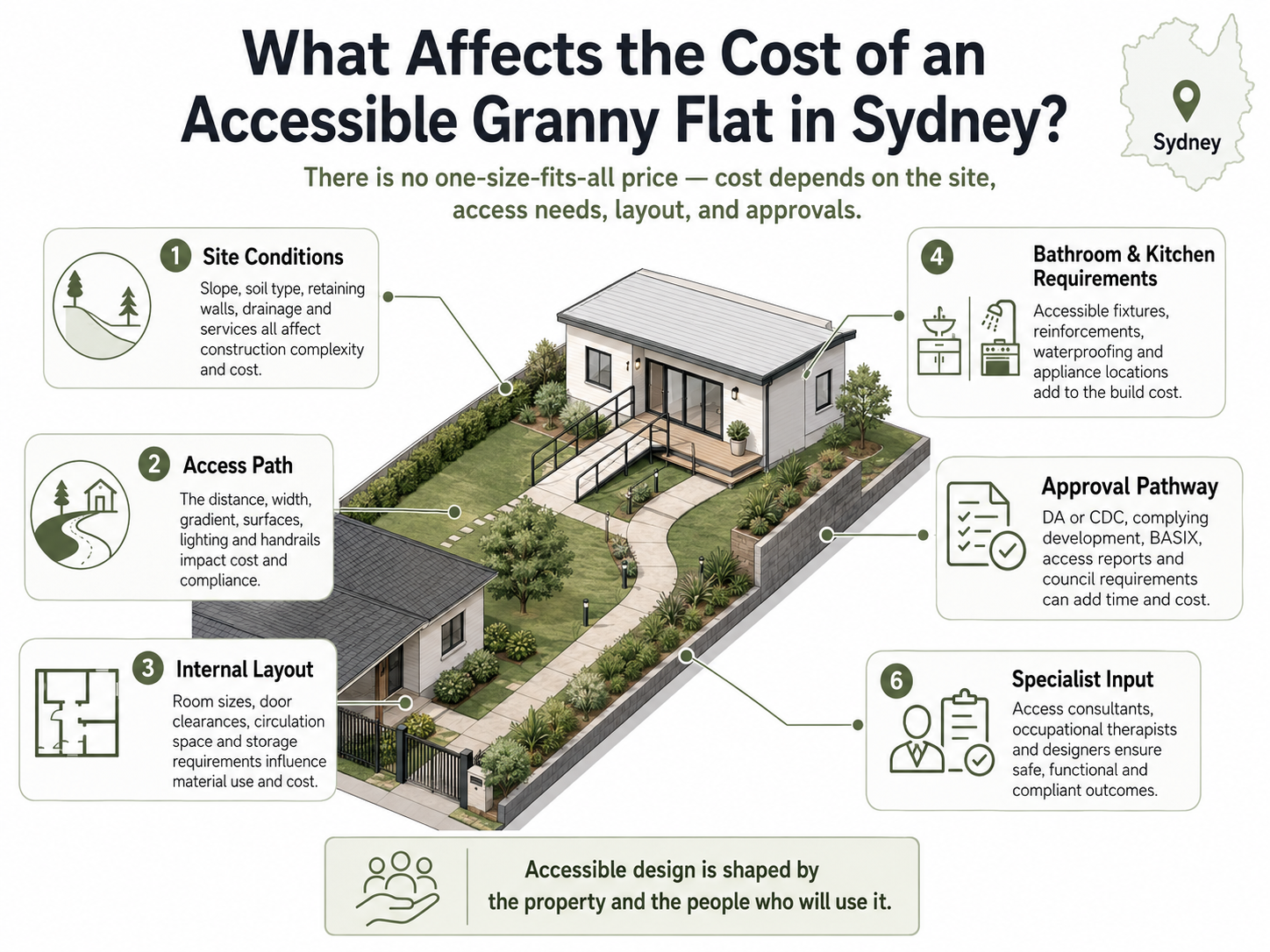
This is why cost can vary between projects. The final budget depends on:
- the existing site conditions
- the movement path across the property
- the level of access needed
- the internal layout
- bathroom and kitchen requirements
- the likely approval pathway
- whether any specialist consultant input is needed
Accessible design is not one fixed package. It is shaped by the property and the people who will actually use the space.
Accessibility Does Not Stop at the Floor Plan
One of the biggest misunderstandings around accessible granny flat cost is assuming it only relates to internal features.
In reality, cost can also be shaped by what happens outside the granny flat itself. Site levels, step-free threshold options, ramp feasibility, landing areas, side access, entry paths, and the connection between the main house and the granny flat can all influence the design response.
A layout may look suitable on paper, but if the outdoor access path is steep, narrow, or difficult to connect properly, that can affect both practicality and cost.
This is why accessible design needs to be assessed across the full site rather than limited to internal rooms alone.
The Site Plays a Major Role
As with any granny flat project, the site has a strong influence on cost.
A relatively flat block with straightforward side access and an easy path to the backyard will usually allow for a more efficient build than a site with level changes, tighter access, awkward entry points, or external circulation challenges.
This is especially important for accessible granny flats, because movement to and from the dwelling matters just as much as movement inside it.
That is why the cost conversation should begin with the site, not with a generic price range alone.
Layout Decisions Affect Cost and Usability
A well-planned layout can improve both accessibility and budget efficiency.
The strongest accessible layouts often focus on simpler circulation, fewer tight corners, more practical room relationships, easier bathroom positioning, and better movement through kitchen and living areas. When this is resolved early, the granny flat can feel more comfortable and easier to use without relying on unnecessary complexity.
On the other hand, trying to force accessibility into a layout too late can lead to compromise, redesign, or additional cost.
This is one reason accessible granny flat design should be considered from the beginning rather than treated as a late-stage adjustment.
Bathroom and Kitchen Requirements
Bathrooms and kitchens are often the spaces where accessibility planning has the greatest impact.
In bathrooms, cost may be affected by circulation space, shower design, fixture positioning, safer transitions, and the level of adaptability being planned. In kitchens, it may come down to movement paths, bench arrangement, storage access, and how easily the space supports everyday independence.
Not every project needs the same solution. The goal is not to over-design the space. It is to make sure the home works properly for the household using it.
Approval Pathway and Specialist Input
Approval requirements can also influence the overall cost.
Depending on the site and the design, some projects may be able to proceed under a complying development pathway, while others may require a development application or further consultant input. That can affect documentation, timeline, and coordination.
This should be reviewed early, especially on accessible projects where site response and layout requirements may be more specific.
Accessible Design Does Not Mean Clinical Design
Some homeowners assume an accessible granny flat will automatically be more expensive because it must feel specialised or medical.
That is not the goal.
A well-designed accessible granny flat should still feel warm, modern, and comfortable to live in. The aim is not to create a clinical-looking home. It is to create a practical, family-focused space that supports dignity, ease of movement, and long-term comfort.
The right design approach often comes from making smarter decisions early, not simply adding more features.
Our Builder-Led Planning Approach
At GrannyFlow, the process starts with understanding how the household needs to live and how the site actually works.
That typically includes:
- understanding the mobility and living requirements of the household
- reviewing side access, site levels, and the movement path
- developing a suitable accessible concept
- checking the likely approval pathway and any consultant requirements where relevant
- providing a clearer construction pathway and quotation
That builder-led process helps create a more grounded and realistic view of cost, rather than relying on a generic estimate disconnected from the property.
Final Thoughts
The cost of an accessible granny flat in Sydney depends on much more than a base build figure.
It is shaped by the household’s needs, the site, the movement path, the layout, the level of accessibility required, and the planning pathway needed to deliver the project properly.
That is why the strongest starting point is not a theoretical price — it is a practical site and design review.
When the site, access path, and family needs are understood early, the project becomes easier to price clearly and plan properly.
Find Out What You Can Build on Your Land
Planning an accessible, mobility-friendly or future-ready granny flat?
GrannyFlow can review your site, access, levels and likely approval pathway to help you understand what may be practical before moving into detailed design.
Find Out What You Can Build on Your Land
Explore Accessible Granny Flats in Sydney
Initial assessment only. Detailed design, approval advice and consultant input may be quoted separately where required.
FAQ
Are accessible granny flats more expensive than standard granny flats?
Not always. Cost depends on the site, the design, and the level of accessibility required. In many cases, better planning early is more efficient than retrofitting changes later.
What affects the cost of an accessible granny flat the most?
Key factors include site levels, side access, step-free entry options, internal layout, bathroom and kitchen planning, and the overall movement path between the main house and the granny flat.
Do accessible features always require specialist consultants?
Not always. Some projects can be resolved through practical design and planning, while others may require specialist input depending on the site and the level of accessibility needed.
Can site conditions increase the cost of an accessible granny flat?
Yes. External access, level changes, ramp feasibility, landing areas, and the connection between the main house and granny flat can all affect the design response and overall cost.


