 Skip to main content Skip to footer


Mobility-friendly granny flat design is about making daily movement easier, safer, and more comfortable.
When a granny flat is designed for an older resident, someone with reduced mobility, or a family member whose needs may change over time, the layout needs to support independence without making the home feel clinical. The goal is to create a space that feels warm, practical, private, and easy to live in.
A mobility-friendly granny flat should not only focus on one feature, such as a wider doorway or a grab rail. It should look at the whole experience of moving through the property: arriving at the entrance, opening the door, moving between rooms, using the bathroom, cooking, accessing storage, going outside, and staying connected with family.
At GrannyFlow, we believe mobility-friendly design should be planned from the beginning. It is much easier to design a safer, more comfortable granny flat early than to retrofit major changes after construction.
Mobility Friendly Granny Flat Design: What It Means
Mobility-friendly granny flat design means the dwelling is easier to move through and use.
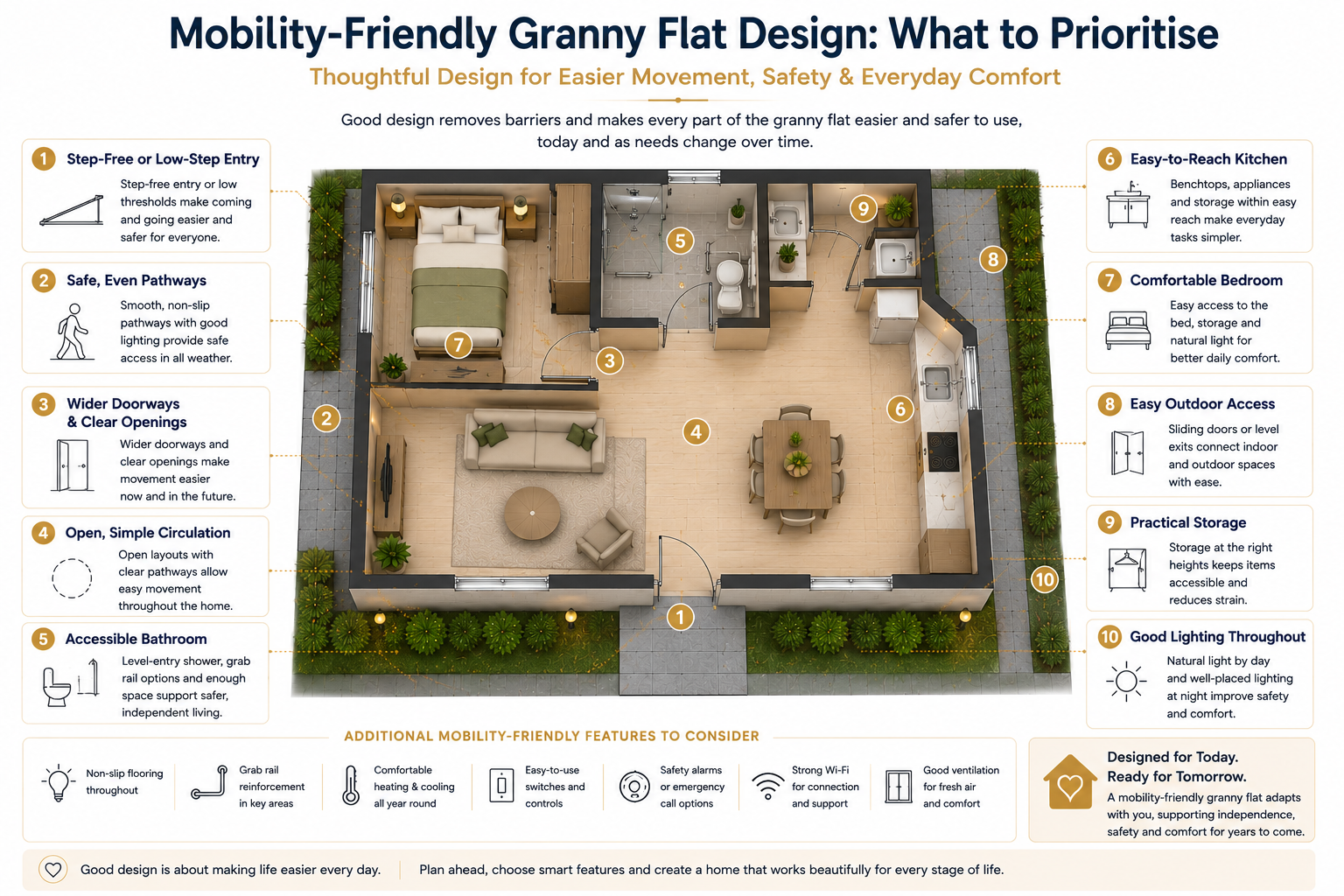
This may include wider circulation, safer bathroom access, fewer trip hazards, better lighting, easier doorways, practical storage, step-free or low-step entry where possible, and a layout that reduces awkward movement.
It does not always mean the granny flat needs to look like an aged care facility.
A mobility-friendly granny flat can still feel modern, warm, and residential. The difference is that the design quietly supports movement, comfort, and safety.
This connects closely to how important accessibility design is in a granny flat, because mobility-friendly planning is one part of broader accessible design.
The best designs make life easier without making the resident feel limited.
Start With the Person Who Will Use the Space
The first priority is understanding the person who will live in the granny flat.
Mobility needs are not the same for everyone. Some people may simply need fewer steps and better lighting. Others may need room for a walking frame, wheelchair access, safer bathroom movement, or future care support.
Before choosing a layout, homeowners should ask:
- Who will use the granny flat?
- Are there current mobility needs?
- Could mobility needs change over time?
- Will the resident use a walking stick, walker, or wheelchair?
- Is bathroom safety a concern?
- Will carers or family members need to assist?
- Does the person need close connection to the main house?
- How independent should the space feel?
This connects to how to plan a granny flat for elderly parents.
A mobility-friendly design should be based on real daily routines, not assumptions.
Site Access Comes First
Mobility-friendly design starts before reaching the front door.
The path from the street, driveway, parking area, or main house to the granny flat needs to be safe and practical. If the path is steep, uneven, narrow, poorly lit, or exposed to weather, the granny flat may be difficult to use even if the internal layout is good.
This connects to how important site access is during granny flat construction.
A mobility-friendly access path should consider:
- smooth surfaces
- minimal level changes
- safe gradients where possible
- good lighting
- clear width
- handrail opportunities where needed
- drainage so water does not pool
- safe movement in wet weather
- practical connection to parking or the main house
Access should be planned early because it affects site levels, landscaping, drainage, entry position, and cost.
Step-Free or Low-Step Entry
The entry is one of the most important parts of a mobility-friendly granny flat.
A step at the front door may seem small, but it can become a major barrier for someone using a walker, wheelchair, or mobility aid. Even for someone who is still independent, steps can become harder with age.
Where possible, a step-free or low-step entry should be considered.
This may involve careful site levels, ramp planning, threshold selection, landing space, door placement, and drainage. The entry should also be protected from water and weather where possible.
This connects to accessible granny flats in Sydney: key design features to consider.
A safe entry helps the resident maintain independence and reduces the risk of falls.
Wider Doorways and Clear Openings
Doorway width matters in a mobility-friendly granny flat.
A narrow doorway can make movement difficult, especially if the resident uses a walker, wheelchair, or requires assistance from another person. Wider doorways can make the space easier to use now and more adaptable later.
This is especially important for:
- main entry
- bedroom doors
- bathroom doors
- laundry access
- hallway openings
- sliding doors to outdoor areas
The goal is to make movement feel natural and less restrictive.
This connects to how to future-proof a granny flat for changing mobility needs.
Even if full wheelchair access is not needed today, wider openings can make the granny flat more comfortable and future-ready.
Simple, Open Circulation
Circulation is one of the most important design priorities.
A mobility-friendly granny flat should avoid tight corners, narrow hallways, awkward room transitions, cluttered entries, and furniture arrangements that make movement difficult. The resident should be able to move from room to room without constantly adjusting, turning sharply, or navigating obstacles.
This connects to granny flat layout ideas for safer elderly living.
A simple layout usually works best.
The bedroom, bathroom, kitchen, and living area should connect logically. The path to the bathroom should be especially clear, because night-time movement can be a safety concern.
Good circulation does not need to make the granny flat feel oversized. It simply needs to remove unnecessary friction.
Avoid Unnecessary Level Changes
Level changes can create mobility challenges.
Steps between indoor and outdoor areas, raised thresholds, uneven flooring transitions, sunken areas, or sloped paths can all increase fall risk. These should be reduced where possible.
A mobility-friendly granny flat should aim for smooth transitions between spaces.
This is especially important between:
- bedroom and bathroom
- living area and kitchen
- entry and hallway
- bathroom and laundry
- indoor and outdoor areas
- granny flat and main house pathway
This connects to mobility-friendly granny flat design: what to prioritise, because movement should be considered as a continuous experience.
If level changes cannot be avoided, they should be made as safe and visible as possible.
Bathroom Safety Is a Top Priority
The bathroom is usually the most important room in a mobility-friendly granny flat.
Wet surfaces, tight spaces, low lighting, awkward fixtures, and poor circulation can all create safety concerns. A well-designed bathroom can make daily living much easier and more independent.
This connects to accessible bathroom features to consider in a granny flat and granny flat bathroom design: small details that matter.
A mobility-friendly bathroom may include:
- walk-in shower
- slip-resistant flooring
- good lighting
- practical vanity height
- easy-to-use taps
- enough room to move
- grab rail planning
- shower seating where needed
- clear toilet access
- good ventilation
- emergency call point if required
The bathroom should be designed for safety, comfort, and dignity.
Walk-In Shower Design
A walk-in shower can be very useful for mobility-friendly design.
It can reduce the need to step over a high threshold, making shower access easier and safer. The shower should be large enough to use comfortably and should allow for future support if needed.
This does not mean the bathroom needs to look institutional.
A walk-in shower can still feel modern and clean if the tiles, screen, fixtures, and layout are chosen carefully.
Important details include drainage, floor fall, waterproofing, slip resistance, screen placement, and space to move.
This connects to how important bathroom design is in a granny flat.
A shower that is easy to enter, use, and clean can make the whole granny flat more practical.
Grab Rail Planning
Grab rails are often associated with aged care design, but they can be planned discreetly.
Even if grab rails are not installed immediately, wall reinforcement can be added during construction so they can be installed later if needed. This is a smart future-proofing decision.
This connects to how to future-proof a granny flat for changing mobility needs.
Grab rail planning may be useful near:
- shower
- toilet
- bathroom entry
- hallway if needed
- external entry
- ramp or path areas
- bedroom support zones
The goal is to make future changes easier without major wall reconstruction.
Planning ahead can save cost and disruption later.
Slip-Resistant Flooring
Flooring is a major safety factor.
A mobility-friendly granny flat should use flooring that is stable, durable, easy to clean, and less likely to cause slips or trips. This is especially important in bathrooms, laundries, kitchens, entries, and outdoor paths.
This connects to how important flooring choice is in a granny flat.
Good flooring should avoid:
- slippery wet surfaces
- loose rugs
- high thresholds
- uneven transitions
- overly glossy finishes
- difficult-to-clean textures
- sudden level changes
Flooring should support confidence.
If the resident feels unsure walking through the home, the design is not doing its job properly.
Lighting for Safer Movement
Lighting is essential in a mobility-friendly granny flat.
Poor lighting can make it harder to see steps, edges, doorways, switches, furniture, and bathroom surfaces. This can increase the risk of trips or falls, especially at night.
This connects to how important lighting is in a granny flat and smart safety features for granny flats used by older residents.
Important lighting areas include:
- entry path
- front door
- hallway
- bedroom
- bathroom
- kitchen
- laundry
- wardrobe areas
- outdoor paths
- switches and controls
Motion-sensor night lighting can be especially useful between the bedroom and bathroom.
Good lighting should feel warm and comfortable, not harsh.
Bedroom Placement and Movement
The bedroom should be easy to access and easy to move around in.
A mobility-friendly bedroom needs enough space around the bed, practical wardrobe access, good lighting, reachable switches, and a clear path to the bathroom.
This connects to granny flat layout ideas for safer elderly living.
Bedroom planning should consider:
- bed position
- room to move beside the bed
- wardrobe door type
- power points near the bed
- lighting controls
- emergency call options if needed
- clear path to bathroom
- window placement
- heating and cooling
- storage access
A bedroom should not be squeezed into a tight corner simply to save space elsewhere.
Daily movement matters.
Bathroom Close to the Bedroom
For older residents or anyone with mobility needs, the bathroom should be close to the bedroom.
This is especially important at night. A long or awkward path between the bedroom and bathroom can increase risk and reduce comfort.
The path should be clear, well lit, and free from obstacles.
This connects to accessible bathroom features to consider in a granny flat.
In some layouts, placing the bathroom near the bedroom can improve safety and convenience. However, privacy, ventilation, plumbing, and layout efficiency still need to be considered.
The goal is to make daily routines easier and safer.
Kitchen Accessibility
The kitchen should be easy to use without excessive reaching, bending, or twisting.
A mobility-friendly kitchen should support safe cooking, storage, cleaning, and movement. The resident should be able to access key items comfortably and move between the sink, fridge, bench, and cooking area without difficulty.
This connects to granny flat kitchen design ideas for compact spaces and how important kitchen design is in a granny flat.
Important kitchen considerations include:
- easy-to-reach storage
- drawers instead of deep cupboards where useful
- good task lighting
- safe appliance placement
- clear bench space
- suitable tapware
- slip-resistant flooring
- enough circulation
- simple controls
- good ventilation
A kitchen should support independence, not make simple tasks harder.
Storage That Is Easy to Reach
Storage should be designed around practical reach.
High cupboards, deep shelves, low corner cabinets, and awkward wardrobes can be difficult for someone with limited mobility. A mobility-friendly granny flat should make everyday items easy to access.
This connects to granny flat storage ideas for smaller layouts.
Useful storage ideas include:
- drawers instead of deep cupboards
- reachable shelves
- pull-out pantry systems
- wardrobe drawers
- lower hanging rails
- bathroom storage at comfortable height
- linen storage that does not require climbing
- laundry storage within easy reach
- clear open space around storage areas
Storage should reduce clutter without creating new physical challenges.
Laundry Planning for Mobility
Laundry planning can affect independence.
If the laundry is hard to access, too tight, poorly lit, or located outside with uneven access, it may become difficult for the resident to use. A mobility-friendly granny flat should make laundry tasks as simple as possible.
This connects to granny flat laundry ideas: internal or external.
An internal laundry or well-designed laundry cupboard may be more practical for older residents than an exposed external laundry.
Laundry planning should consider:
- appliance height
- door access
- basket movement
- storage
- ventilation
- lighting
- drying area
- floor safety
- access to outdoor clothesline if used
The laundry should not require difficult carrying, bending, or outdoor movement where avoidable.
Outdoor Access and Safe Paths
Outdoor areas can improve quality of life, but they need to be safe.
A small courtyard, garden area, patio, or sitting space can help the granny flat feel more comfortable and independent. However, outdoor surfaces, steps, slopes, drainage, lighting, and privacy all need to be considered.
This connects to granny flat outdoor living ideas and how important outdoor space is in a granny flat.
A mobility-friendly outdoor area should have:
- smooth surfaces
- safe transitions
- clear access
- shade where needed
- seating opportunities
- good drainage
- lighting
- privacy
- low-maintenance landscaping
- minimal trip hazards
Outdoor space should be enjoyable, not risky or difficult to use.
Landscaping for Mobility and Safety
Landscaping can support mobility-friendly design when planned carefully.
Planting, paths, screens, garden edges, and outdoor surfaces can all affect movement. Low-maintenance landscaping is usually best for older residents because it reduces upkeep and keeps pathways clearer.
This connects to how important landscaping around a granny flat is.
Landscaping should not create:
- overgrown paths
- uneven surfaces
- slippery leaf fall
- difficult garden maintenance
- hidden edges
- poor visibility
- blocked access
Good landscaping can improve privacy, comfort, shade, and safety at the same time.
Parking and Drop-Off Access
Parking and drop-off areas matter for mobility-friendly granny flats.
The resident may need convenient access from a car, taxi, family vehicle, support worker, or medical transport. The path from parking to the granny flat should be simple and safe.
This connects to how important parking consideration is for a granny flat.
Important questions include:
- Where will the resident be dropped off?
- Is the path to the entry smooth?
- Is there enough lighting?
- Is the pathway protected from rain?
- Is there space for mobility aids?
- Can family or carers access the granny flat easily?
- Is parking causing conflict with the main house?
Parking and access should be planned together, not separately.
Door Handles, Taps and Hardware
Small hardware choices can make daily life easier.
Lever handles are often easier to use than round knobs. Easy-turn taps can be more practical than stiff controls. Cabinet handles should be easy to grip. Sliding doors should be smooth and not too heavy.
These details may seem minor, but they affect daily comfort.
This connects to granny flat bathroom design: small details that matter.
Mobility-friendly hardware should be:
- easy to grip
- easy to see
- simple to operate
- durable
- positioned at practical heights
- not overly delicate
- suitable for long-term use
Good hardware supports independence without drawing attention to itself.
Smart Safety Features
Smart safety features can support mobility-friendly design.
Motion-sensor lights, video doorbells, emergency call buttons, fall detection devices, leak sensors, smart locks, and temperature controls can all add reassurance when used appropriately.
This connects directly to smart safety features for granny flats used by older residents.
Technology should be simple and reliable.
The resident should not need to manage complicated apps or confusing controls. Smart features should reduce stress, not add complexity.
The best approach is to choose features that solve real daily needs.
Heating, Cooling and Comfort
Temperature comfort is important for older residents and people with mobility needs.
A granny flat that becomes too hot or too cold can quickly become uncomfortable. The design should consider insulation, window placement, shading, ventilation, heating, and cooling from the beginning.
This connects to how important heating and cooling is in a granny flat and energy efficient granny flat design: what helps most.
Comfort is not only about luxury.
For some residents, temperature stability can affect health, sleep, energy, and daily wellbeing.
A mobility-friendly granny flat should feel comfortable throughout the year.
Natural Light and Visibility
Natural light can improve comfort and visibility.
A bright granny flat can feel safer, more welcoming, and easier to move through. Natural light can also reduce reliance on artificial lighting during the day.
This connects to north-facing granny flats: how to use natural light well and how important natural light is in a granny flat.
However, natural light should be balanced with glare control and privacy.
Too much glare can make movement harder, especially for older residents with vision sensitivity. Window coverings, shading, and careful room orientation can help.
Good light should make the home easier to use.
Ventilation and Indoor Air Quality
Ventilation supports comfort, moisture control, and indoor air quality.
A mobility-friendly granny flat should feel fresh and easy to live in. Poor ventilation can create stuffiness, odours, bathroom humidity, cooking smells, and moisture issues.
This connects to how important ventilation is in a granny flat.
Ventilation is especially important in:
- bathroom
- kitchen
- laundry
- bedroom
- living area
- storage areas
Good airflow helps maintain comfort and reduces maintenance problems over time.
A safe home should also be a healthy home.
Acoustic Comfort
Mobility-friendly design should also consider noise.
Older residents may be more sensitive to noise from the main house, neighbours, traffic, outdoor areas, or mechanical systems. A calm environment can improve comfort and wellbeing.
This connects to how important acoustic privacy is in a granny flat.
Acoustic comfort can be improved through:
- building position
- window selection
- insulation
- room placement
- soft furnishings
- landscaping
- avoiding noisy service areas near bedrooms
- separating the granny flat from high-traffic paths
A mobility-friendly granny flat should feel peaceful, not only physically accessible.
Privacy and Independence
Privacy is important for dignity and independence.
An older resident may want to live close to family but still have their own private home. The granny flat should provide enough separation from the main house while still allowing connection when needed.
This connects to privacy ideas for granny flats on shared properties and how a granny flat can support independent living close to family.
Privacy can be improved through:
- entry placement
- window planning
- landscaping
- fencing
- outdoor zoning
- bathroom placement
- bedroom orientation
- acoustic separation
Mobility-friendly design should support independence, not make the resident feel constantly watched or dependent.
Carer and Family Support Access
If carers or family members may assist the resident, the design should allow for that.
Support access may affect bathroom size, bedroom layout, entry design, parking, storage, and circulation. A granny flat that is too tight may make assistance difficult.
This connects to can a granny flat make caring for family easier.
The design should consider:
- whether a carer may enter regularly
- whether bathroom assistance may be needed
- whether medical equipment may be used
- whether bedroom space is sufficient
- whether entry access works for support visits
- whether storage is needed for mobility aids
- whether communication with the main house is easy
Planning for support does not mean the resident loses independence. It simply makes help easier if needed.
Future-Proofing for Changing Mobility Needs
Mobility needs can change over time.
A resident who walks comfortably today may need a walking frame later. Someone who does not need bathroom support now may need grab rails in the future. A layout that feels generous today may need to support assistance later.
This connects directly to how to future-proof a granny flat for changing mobility needs.
Future-proofing may include:
- wider doorways
- reinforced bathroom walls
- step-free entry planning
- clear circulation
- accessible storage
- flexible bathroom layout
- good lighting
- space for mobility aids
- simple technology readiness
- safer outdoor paths
Future-proofing is not about overbuilding. It is about making sensible decisions early.
Mobility-Friendly Design for Rental Use
Some accessible granny flats may eventually be rented.
A mobility-friendly design can improve rental appeal for tenants who need easier movement, older occupants, or people wanting a safer compact home.
This connects to what makes a granny flat more appealing to tenants and what tenants usually want in a granny flat rental.
For rental use, mobility-friendly features should be durable, simple, and easy to maintain. The design should not feel too specialised unless the target tenant clearly needs it.
A good balance can make the dwelling more flexible for different future occupants.
Mobility-Friendly Design for Family Use
Many mobility-friendly granny flats are built for family.
This may include elderly parents, relatives, carers, adult children with disability, or family members recovering from illness or injury. In these cases, emotional comfort matters as much as physical design.
This connects to why granny flats work well for multigenerational living.
A family-use granny flat should feel warm and personal. It should support independence, privacy, safety, and connection.
The design should make daily life easier without making the resident feel like they are living in a facility.
Cost Considerations
Mobility-friendly design can affect cost, but not every improvement is expensive.
Some choices are simply smarter planning decisions made early. Wider circulation, better lighting, safer flooring, practical bathroom layout, and step-aware access can often be included more efficiently when considered from the beginning.
Other features may add cost, such as larger bathrooms, reinforced walls, ramps, smart safety systems, upgraded flooring, or custom joinery.
Understanding granny flat cost in Sydney helps place these decisions within the full project budget.
This also connects to hidden granny flat costs homeowners often miss.
The key is to prioritise features that create real daily benefit.
Approval and Compliance
A mobility-friendly granny flat still needs to follow the correct approval pathway.
Depending on the property and design, the project may proceed through CDC or DA. The layout, site access, services, drainage, setbacks, and documentation all need to be considered.
Understanding CDC vs DA for granny flats helps clarify this stage.
If the design includes specific accessibility or mobility features, these should be planned with the broader design and documentation process.
Accessibility should not be treated as a late upgrade.
It should be part of the project from the start.
Common Mobility-Friendly Design Mistakes
Common mistakes include:
- leaving accessibility until after the layout is finished
- making the bathroom too small
- ignoring the entry path
- keeping narrow doorways
- using slippery flooring
- placing storage too high
- poor lighting between bedroom and bathroom
- adding grab rails without wall preparation
- forgetting outdoor paths
- not planning for future mobility aids
- choosing a layout that does not allow support access
- focusing only on appearance instead of daily use
This connects to common mistakes when building a granny flat.
Most mobility-friendly mistakes are easier to avoid before construction begins.
Once the granny flat is built, changes can be more expensive and disruptive.
Why a Site Check Helps
A site check is especially important for mobility-friendly granny flat design.
It can review access, levels, slope, drainage, parking, entry position, outdoor paths, privacy, services, and where the granny flat can sit most practically. These site conditions affect how easy and safe the finished dwelling will be to use.
If mobility is a priority, Find Out What You Can Build on Your Land before choosing a layout.
A site-first approach helps create a design that supports real movement through the property, not just inside the floor plan.
Final Thoughts
Mobility-friendly granny flat design should focus on safe, comfortable, and independent daily living.
The most important priorities include site access, step-free or low-step entry, wider doorways, clear circulation, safer bathroom design, slip-resistant flooring, good lighting, practical storage, easy kitchen use, safe outdoor paths, heating and cooling, privacy, and future flexibility.
The best mobility-friendly granny flats do not feel clinical.
They feel calm, practical, and easy to live in. They support the resident quietly through good design decisions that make movement simpler and safer.
When planned early, mobility-friendly design can help a granny flat remain useful, comfortable, and adaptable for many years.
Find Out What You Can Build on Your Land
Planning a mobility-friendly, accessible or future-ready granny flat?
GrannyFlow can review your site, access, levels and likely approval pathway to help you understand what may be practical before moving into detailed design.
Find Out What You Can Build on Your Land
Explore Accessible Granny Flats in Sydney
FAQ: Mobility-Friendly Granny Flat Design
What makes a granny flat mobility-friendly?
A mobility-friendly granny flat includes safer access, wider doorways, clear circulation, fewer trip hazards, slip-resistant flooring, good lighting, practical bathroom design, easy-to-reach storage, and a layout that supports independent movement.
Does a mobility-friendly granny flat need to be wheelchair accessible?
Not always. Mobility-friendly design can support people with different needs, including walkers, walking sticks, reduced balance, or age-related movement changes. Full wheelchair accessibility may require additional design considerations.
What is the most important room to plan for mobility?
The bathroom is usually the most important room because wet surfaces, tight spaces, and poor lighting can create safety risks. A walk-in shower, slip-resistant flooring, good lighting, and grab rail planning can make a major difference.
Should mobility-friendly features be added during construction or later?
It is better to plan them during design and construction. Features such as wider doorways, bathroom wall reinforcement, step-free entry, and safer circulation are much easier to include early than retrofit later.


