 Skip to main content Skip to footer


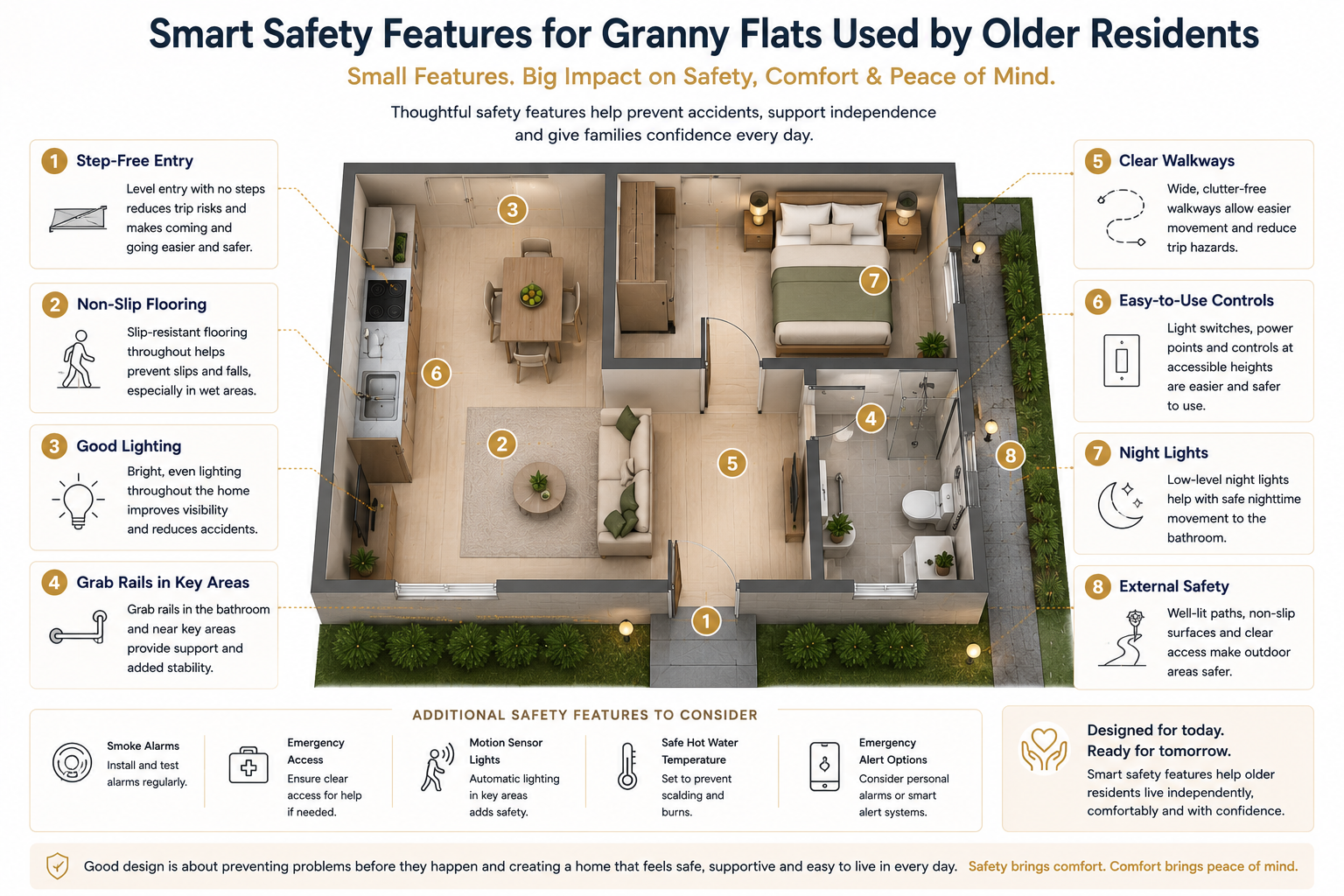
Smart safety features can make a granny flat more comfortable, practical, and reassuring for older residents.
When a granny flat is used by an elderly parent or older family member, the design needs to support independence without removing safety, comfort, or connection. The goal is not to make the home feel clinical or overcomplicated. The goal is to add simple, useful features that make daily living easier and help family members feel more confident.
A granny flat for older residents should be planned around movement, visibility, access, lighting, bathroom safety, communication, security, emergency awareness, and comfort. Smart features can support these areas when they are chosen carefully and integrated into the design from the beginning.
At GrannyFlow, we believe smart safety should support the resident’s independence. Technology should make life easier, not harder. The best features are simple, reliable, easy to use, and matched to the needs of the person living in the granny flat.
Smart Safety Features for Granny Flats: Why They Matter
Smart safety features matter because older residents may need more support around movement, comfort, security, and everyday routines.
A granny flat can provide independence close to family, but the space should still be designed to reduce avoidable risks. Good lighting, safer bathroom planning, easy access, clear communication, and practical monitoring can all make a major difference.
This connects closely to how to plan a granny flat for elderly parents and how important accessibility design is in a granny flat.
Smart safety does not mean filling the granny flat with complicated devices. In many cases, the most effective features are simple:
- motion-sensor lighting
- easy-to-use smart locks
- video doorbell
- emergency call button
- fall detection device
- smoke and heat alerts
- smart lighting controls
- temperature monitoring
- security cameras in external areas
- voice-controlled assistance
- appliance safety features
The key is choosing features that match the resident’s lifestyle and comfort level.
Start With the Resident’s Daily Routine
The best smart safety plan starts with the older resident’s daily routine.
Different people need different levels of support. Some older residents are very independent and only need basic safety features. Others may need more support with mobility, memory, medication routines, bathroom safety, or emergency communication.
Before choosing technology, the family should consider:
- how the resident moves through the space
- whether mobility support is needed
- whether night-time movement is common
- whether falls are a concern
- whether memory reminders are useful
- how often family members check in
- whether the resident is comfortable using technology
- whether the granny flat will be used long term
- whether needs may change over time
This connects to how to future-proof a granny flat for changing mobility needs.
Smart safety features should support the real person using the space, not just follow a generic checklist.
Keep Technology Simple
Smart features should be easy to use.
A safety system that feels confusing may not be used properly. Older residents may not want too many apps, passwords, switches, remotes, or voice commands. The best setup is usually simple, predictable, and low-maintenance.
For example, motion lighting may be more useful than a complicated lighting app. A simple emergency button may be better than a device that requires multiple steps. A smart lock should be easy to override with a key if needed.
The goal is to reduce stress, not add another layer of complexity.
This is especially important when the granny flat is designed for aging in place.
Technology should feel supportive and almost invisible in daily use.
Motion-Sensor Lighting
Motion-sensor lighting is one of the most useful safety features for older residents.
It can help reduce the risk of trips or falls when moving through the granny flat at night. It can also make entries, hallways, bathrooms, wardrobes, outdoor paths, and laundry areas easier to use.
Motion lighting can be especially helpful in:
- bedroom paths
- bathroom entries
- hallway areas
- kitchen zones
- external pathways
- entry doors
- laundry areas
- wardrobes
- outdoor steps or ramps
This connects to how important lighting is in a granny flat and how important accessibility design is in a granny flat.
The lighting should be gentle enough not to feel harsh at night, but bright enough to support safe movement.
A well-lit path from the bedroom to the bathroom can make a major difference.
Smart Lighting Controls
Smart lighting controls can make the granny flat easier to use.
Older residents may benefit from being able to turn lights on and off from one place, use remote controls, or rely on preset lighting scenes. This can reduce the need to walk through dark areas or reach awkward switches.
Smart lighting can also support routines.
For example, lights may be set to turn on softly in the morning, brighten during the evening, or switch on automatically near the entry after sunset.
However, lighting controls should remain simple.
A standard wall switch should still work clearly. Smart controls should add convenience, not replace basic usability.
This connects to energy efficient granny flat design: what helps most, because lighting can support both comfort and efficiency when planned well.
Safer External Pathway Lighting
External lighting is important because the resident may move between the granny flat and the main house.
The pathway should be safe, visible, and easy to follow at night. Poor lighting can make even a short walk feel unsafe, especially in rain or uneven outdoor conditions.
This connects to how important site access is during granny flat construction and privacy ideas for granny flats on shared properties.
External lighting may include:
- motion-sensor path lights
- entry lights
- step lighting
- ramp lighting
- garden path lighting
- sensor lights near gates
- lighting near bin areas
- lighting between the main house and granny flat
The goal is to make movement clear without making the outdoor area feel exposed or harsh.
Pathway lighting should improve safety, comfort, and independence.
Video Doorbell
A video doorbell can be useful for older residents who want to see who is at the door before opening it.
This can improve security and peace of mind. It may also help family members monitor deliveries, visitors, or unexpected activity if permissions and privacy are clearly agreed.
A video doorbell can be especially helpful if the granny flat has a separate entry.
This connects to how important security is in a granny flat.
For older residents, the system should be easy to use. The display or notification should be clear, and the resident should not need to manage complicated settings.
A video doorbell should support safety while respecting independence and privacy.
Smart Locks and Keyless Entry
Smart locks or keyless entry can make access easier when used carefully.
They may help older residents avoid fumbling with keys, especially at night or while carrying items. They can also allow trusted family members to access the granny flat in an emergency.
However, smart locks should be chosen with reliability in mind.
There should always be a backup method, such as a physical key or secure manual override. Battery maintenance should also be considered so the lock does not fail unexpectedly.
Smart locks can be useful for:
- elderly parents
- carers
- family check-ins
- emergency access
- guest access
- rental flexibility later
The lock should feel simple, secure, and easy to operate.
Emergency Call Buttons
An emergency call button can provide reassurance for older residents and family members.
This may be a wall-mounted button, wearable pendant, watch-based alert, or simple connected device. The purpose is to allow the resident to call for help quickly if something goes wrong.
Emergency call systems can be useful near:
- bedroom
- bathroom
- shower area
- living area
- kitchen
- entry
- outdoor sitting area
This connects to how to plan a granny flat for elderly parents.
The system should be easy to reach and easy to understand. If the resident is unlikely to wear a device or remember how to use it, the family may need a simpler setup.
Emergency support should be planned around real behaviour, not ideal behaviour.
Fall Detection Devices
Fall detection can be useful when fall risk is a concern.
This may be built into a wearable device, pendant, smartwatch, or monitoring system. It can help alert family members or support services if a fall is detected.
Fall detection should not replace good design.
The granny flat should still include safer flooring, good lighting, clear circulation, accessible bathroom design, and minimal trip hazards.
This connects to mobility-friendly granny flat design: what to prioritise and granny flat layout ideas for safer elderly living.
Technology can help respond to an incident, but design should reduce the chance of incidents happening in the first place.
Smoke, Heat and Carbon Monoxide Alerts
Safety alarms are essential in any dwelling.
Smart smoke, heat, or carbon monoxide alerts can provide extra reassurance by sending notifications to connected devices or family members. This can be helpful if the older resident does not hear an alarm clearly or if family members want awareness of an emergency.
The granny flat should still meet all required safety and compliance standards.
Smart alarms should be seen as an additional support layer, not a replacement for required safety systems.
This connects to what documents do you need before building a granny flat and what is an occupation certificate for a granny flat, because safety and compliance should be part of the proper build process.
Alarms should be installed, maintained, and tested regularly.
Stove and Appliance Safety Features
Kitchen safety is important when older residents live independently.
Smart appliance features can help reduce risk in the kitchen. This may include automatic shut-off functions, induction cooktops, stove timers, heat alerts, or reminder systems.
This connects to granny flat kitchen design ideas for compact spaces and how important kitchen design is in a granny flat.
Kitchen safety planning may include:
- induction cooktop where suitable
- automatic shut-off appliances
- clear task lighting
- easy-to-reach power points
- safe appliance placement
- non-slip flooring
- simple controls
- good ventilation
- smoke and heat detection
Appliances should be easy to operate and not overly complicated.
A safer kitchen is one that supports independence without creating unnecessary risk.
Bathroom Safety Technology
The bathroom is one of the most important areas for smart safety planning.
Many risks for older residents happen in wet areas. Smart features can help, but they should be combined with strong bathroom design.
This connects to accessible bathroom features to consider in a granny flat and granny flat bathroom design: small details that matter.
Useful bathroom safety features may include:
- motion-sensor night lighting
- emergency call button
- anti-scald temperature controls
- slip-resistant flooring
- grab rail planning
- walk-in shower
- good ventilation
- easy-to-use taps
- clear lighting around the vanity
- shower seating where needed
Technology should not distract from the basics. The bathroom still needs safe layout, waterproofing, drainage, ventilation, and accessible movement.
Anti-Scald Water Temperature Controls
Water temperature control can be especially important for older residents.
Anti-scald features or temperature-limiting controls can help reduce the risk of burns in the bathroom or kitchen. This can be useful where the resident has slower reaction time, reduced sensation, or difficulty adjusting taps quickly.
This connects to how important plumbing design is in a granny flat.
Water temperature safety should be considered during plumbing planning, not after handover.
A safer plumbing setup supports daily independence and comfort.
It also helps make the granny flat more suitable for long-term family use.
Smart Thermostats and Temperature Monitoring
Temperature comfort matters for older residents.
Some older people may be more sensitive to heat or cold. A smart thermostat or simple temperature monitoring system can help maintain a comfortable indoor environment.
This connects to how important heating and cooling is in a granny flat and energy efficient granny flat design: what helps most.
A smart temperature system may help:
- maintain steady comfort
- reduce overheating
- reduce excessive cold
- allow family check-ins where appropriate
- improve energy efficiency
- simplify heating and cooling control
However, controls should be easy to understand.
A simple system with clear settings is usually better than one that requires complex app management.
Air Quality and Ventilation Monitoring
Air quality can affect comfort in a granny flat.
Ventilation helps manage moisture, odours, cooking smells, bathroom humidity, and indoor freshness. In some cases, smart air quality monitors may help identify poor airflow, high humidity, or stale indoor conditions.
This connects to how important ventilation is in a granny flat.
Air quality monitoring may be useful when:
- the granny flat is compact
- the bathroom has limited natural ventilation
- cooking happens frequently
- the resident spends most of the day indoors
- humidity or mould risk is a concern
- heating and cooling are used often
A monitor is only useful if the design can respond properly.
Good ventilation, windows, exhaust fans, insulation, and moisture control remain the foundation.
Voice-Controlled Assistance
Voice-controlled devices can support older residents when used simply.
They may help with turning lights on, setting reminders, making calls, checking the weather, playing music, or controlling simple smart devices. For some residents, voice control can reduce the need to move around for small tasks.
However, voice assistants are not suitable for everyone.
Some older residents may find them useful, while others may find them confusing or intrusive. Privacy preferences should also be respected.
This connects to smart granny flat ideas for modern living.
Voice control should be optional and practical.
It should support daily comfort without becoming the only way to operate the home.
Medication and Routine Reminders
Smart reminders can help older residents maintain routines.
This may include reminders for medication, appointments, hydration, meals, exercise, or family check-ins. These reminders can come through a smart speaker, phone, tablet, wearable device, or simple digital display.
Routine reminders can support independence, especially when family members are nearby but not constantly present.
However, reminders should be set up in a way the resident accepts and understands.
Too many alerts can become annoying or easy to ignore.
A small number of useful reminders is usually better than a complicated system.
Smart Blinds or Easy Window Controls
Window coverings can affect comfort, privacy, and temperature.
Smart blinds or easy-to-use window controls may help older residents manage light and privacy without struggling with cords, high windows, or awkward mechanisms.
This connects to north-facing granny flats: how to use natural light well and privacy ideas for granny flats on shared properties.
Smart blinds may be useful where:
- windows are hard to reach
- glare needs regular control
- privacy changes throughout the day
- heat needs to be managed
- the resident has limited mobility
However, manual backup should be considered.
Window coverings should be simple, safe, and easy to maintain.
Security Cameras in External Areas
External security cameras can improve awareness around the granny flat.
They may be useful near entries, gates, driveways, or external pathways. For older residents, this can provide reassurance and help family members understand unusual activity around the property.
However, privacy should be respected.
Cameras should not monitor private internal spaces. The resident should know where cameras are placed and why they are being used.
This connects to how important security is in a granny flat and privacy ideas for granny flats on shared properties.
Security features should protect the resident without making the home feel monitored or uncomfortable.
Smart Sensors for Doors and Windows
Door and window sensors can help identify whether an entry point has been left open.
This may be useful for security, weather protection, or general safety. For older residents, it can also provide reassurance if memory or routine changes are a concern.
Sensors may be placed on:
- external doors
- windows
- sliding doors
- side gates
- laundry access doors
- storage areas
The system should be simple and not create too many alerts.
Door and window sensors are most useful when connected to a clear purpose, such as safety, security, or weather protection.
They should not feel intrusive.
Water Leak Detection
Water leak detection can help protect the granny flat from damage.
Small leaks in bathrooms, laundries, kitchens, or hot water systems can create bigger problems if they are not noticed early. A leak detector can alert the resident or family before damage becomes serious.
This connects to how important plumbing design is in a granny flat, granny flat laundry ideas: internal or external, and granny flat bathroom design: small details that matter.
Leak detectors may be useful near:
- bathroom vanity
- laundry area
- washing machine
- kitchen sink
- hot water system
- external service areas
This is especially useful if the resident may not notice a leak quickly or if family members want extra reassurance.
Stove, Door and Routine Check Alerts
Some smart systems can support routine checks.
For example, alerts may help identify whether a stove is still on, a door has been left open, or movement has not been detected for a long period. These systems can provide reassurance, especially when older residents live independently.
However, these features should be selected carefully.
Too many notifications can create stress for family members and reduce trust in the system. The setup should focus on the most important risks.
A simple, reliable alert is better than a complicated system that produces constant false alarms.
The goal is helpful awareness, not constant surveillance.
Non-Slip Flooring Is Still Essential
Smart technology cannot replace safe physical design.
Non-slip flooring is one of the most important safety features in a granny flat for older residents. It helps reduce fall risk and supports safer movement through bathrooms, entries, kitchens, laundries, and outdoor paths.
This connects to mobility-friendly granny flat design: what to prioritise.
Flooring should be chosen for:
- slip resistance
- durability
- ease of cleaning
- comfort underfoot
- smooth transitions
- suitability for wet areas
- low maintenance
A smart sensor may alert someone after a fall, but good flooring helps reduce the chance of a fall happening.
Clear Circulation and Fewer Trip Hazards
A smart granny flat should still have a simple, safe layout.
Clear circulation, wide enough pathways, fewer level changes, and careful furniture placement are all important for older residents. Technology cannot fix a poor layout.
This connects to granny flat layout ideas for safer elderly living.
The design should avoid:
- narrow walkways
- awkward corners
- loose rugs
- poor lighting
- cluttered entries
- raised thresholds
- uneven outdoor paths
- tight bathroom movement
- poorly placed furniture
Smart features work best when the physical space is already safe and easy to move through.
Smart Safety for Night-Time Movement
Night-time movement is a major safety consideration.
Older residents may need to move from the bedroom to the bathroom, kitchen, or entry during the night. The path should be clear, softly lit, and free from obstacles.
Smart night lighting can help here.
This may include:
- low-level motion lights
- bathroom entry lighting
- under-cabinet lighting
- bedside light controls
- hallway sensors
- soft pathway lighting
- illuminated switches
This connects to accessible bathroom features to consider in a granny flat.
The goal is to create enough visibility without fully waking the resident or creating glare.
Smart Safety and Privacy Balance
Smart safety features should always respect privacy.
Older residents may not want to feel watched or controlled. Family members may want reassurance, but the resident’s dignity and independence should remain central.
This is especially important for cameras, movement sensors, door sensors, emergency systems, and health-related reminders.
The best approach is open discussion before installation.
Everyone should understand:
- what features are being added
- what information is collected
- who receives alerts
- where cameras or sensors are placed
- how the resident can control features
- how privacy is protected
Safety should support independence, not remove it.
Smart Safety for Family Peace of Mind
A granny flat used by an older resident often supports the whole family.
Family members may feel more comfortable knowing the resident has good lighting, safe access, secure entry, emergency support, and reliable communication. This can reduce worry while still allowing the resident to live independently.
This connects to how a granny flat can support independent living close to family.
The granny flat should not feel like a care facility. It should feel like a home.
Smart safety features can make that home more reassuring for everyone involved.
Smart Safety and Future-Proofing
Needs may change over time.
A resident who is fully independent today may need more support later. Planning smart safety features early can make it easier to adapt the granny flat without major changes.
This connects to how to future-proof a granny flat for changing mobility needs.
Future-ready planning may include:
- extra power points
- data cabling
- conduit for future systems
- smart lighting readiness
- bathroom wall reinforcement for future grab rails
- space for mobility aids
- easy access for support workers
- simple appliance controls
- flexible security systems
Future-proofing does not mean installing every feature immediately. It means making the granny flat easier to adapt when needed.
Smart Features for Carers and Support Visits
If carers or support workers may visit, smart safety planning can help make visits easier.
Clear access, smart locks, external lighting, video doorbell, security systems, and simple communication tools can all support safer and more organised care arrangements.
This connects to can a granny flat make caring for family easier.
The design should consider:
- where carers enter
- how access is managed
- whether parking or drop-off is needed
- how privacy is maintained
- whether the resident can call for help easily
- whether equipment may be needed later
- whether bathroom access is suitable
Smart features can support care without making the home feel institutional.
Smart Safety and Accessibility Design
Smart safety works best when combined with accessibility design.
Accessibility focuses on physical usability: step-free access, wider paths, safer bathrooms, clear circulation, reachable storage, good lighting, and easy movement. Smart features add support through automation, alerts, monitoring, and convenience.
This connects to accessible granny flats in Sydney: key design features to consider.
For older residents, both parts matter.
A smart lock will not help if the path to the door is unsafe. A fall alert will not replace proper bathroom access. Motion lighting will not fix a cluttered layout.
The strongest design combines physical safety with practical technology.
Avoid Overcomplicating the Granny Flat
One common mistake is adding too many smart features.
A granny flat can become harder to use if it has too many systems, apps, alerts, remotes, and settings. Older residents may feel frustrated or dependent on family members to manage the home.
Smart safety should be selective.
The best features are the ones that solve real problems.
For example, if night-time bathroom movement is the main risk, motion lighting may be more useful than a full smart home system. If emergency communication is the main concern, an easy call button may be more important than complex automation.
Simple and reliable is usually better than advanced and confusing.
Maintenance and Reliability
Smart safety features need maintenance.
Batteries, Wi-Fi connections, app updates, subscriptions, sensors, alarms, and devices may all need ongoing checks. If these systems are not maintained, they may stop working when needed.
This connects to what are the ongoing maintenance costs of a granny flat.
Families should consider:
- who maintains the devices
- how batteries are checked
- whether the internet is reliable
- whether alerts are tested
- whether backup access is available
- whether devices still suit the resident
- whether systems are easy to replace
A smart safety setup is only useful if it remains reliable over time.
Internet and Connectivity
Reliable internet is essential for many smart safety features.
Video doorbells, smart locks, sensors, emergency systems, voice assistants, and monitoring tools may depend on a stable connection. Weak internet can make these features unreliable.
This connects to how important internet and connectivity is in a granny flat.
A granny flat at the rear of a property may not receive strong Wi-Fi from the main house. The design may need a wired connection, mesh system, dedicated access point, or other planned solution.
Connectivity should be considered before relying on smart safety technology.
Power Backup Considerations
Some smart safety features depend on power.
If there is a power outage, lighting, internet, smart locks, cameras, and communication systems may be affected. Backup options may be worth considering for important systems.
This may include:
- battery backup for internet equipment
- devices with battery operation
- manual key backup for smart locks
- emergency lighting
- battery-powered call devices
- regular testing procedures
The goal is not to make the system complicated. The goal is to avoid relying on technology that fails when it is most needed.
Backup planning is part of practical safety.
Cost Considerations
Smart safety features can affect the project budget.
Some features are simple and affordable, such as motion lights or extra power points. Others may involve more cost, such as smart locks, external cameras, data cabling, emergency systems, automation hubs, or integrated monitoring.
Understanding granny flat cost in Sydney helps place smart safety features within the full project budget.
This also connects to what affects granny flat cost the most and hidden granny flat costs homeowners often miss.
The best approach is to prioritise features that provide the most practical benefit.
Safety spending should focus on the resident’s real needs.
Approval and Compliance Considerations
Smart safety features should be considered alongside the broader approval and compliance process.
The granny flat still needs to be designed, approved, built, certified, and handed over properly. Technology does not replace building requirements, accessibility planning, or safety compliance.
Understanding CDC vs DA for granny flats and what is an occupation certificate for a granny flat helps clarify the broader project pathway.
Smart safety should support the approved design.
If features involve electrical work, security systems, plumbing controls, or structural preparation, they should be planned with qualified professionals.
Common Smart Safety Mistakes
Common mistakes include:
- adding too many devices
- choosing features the resident will not use
- relying on weak Wi-Fi
- forgetting backup access
- ignoring battery maintenance
- placing cameras without privacy discussion
- using complicated controls
- installing sensors without clear purpose
- treating technology as a replacement for accessible design
- failing to plan power and data early
- leaving bathroom safety too late
This connects to common mistakes when building a granny flat.
Most smart safety mistakes can be avoided by starting with the resident’s needs and keeping the system simple.
Why a Site Check Helps Smart Safety Planning
A site check can help identify where smart safety features will be most useful.
It can review access paths, lighting needs, entry points, privacy, bathroom position, bedroom location, outdoor areas, services, power, internet, and the relationship between the granny flat and the main house.
If planning a granny flat for an older resident, Find Out What You Can Build on Your Land before finalising the layout or technology plan.
A site-first approach helps make the smart safety features practical rather than random.
Final Thoughts
Smart safety features can make a granny flat more supportive for older residents, but they should be chosen carefully.
The best features are simple, reliable, easy to use, and matched to the resident’s daily routine. Motion lighting, emergency call systems, video doorbells, smart locks, temperature controls, leak detectors, door sensors, and easy communication tools can all support safer independent living.
However, smart technology works best when the physical design is already strong.
Good lighting, accessible bathrooms, safe flooring, clear pathways, privacy, ventilation, heating and cooling, and reliable connectivity all matter. A safe granny flat is created through both design and technology working together.
The goal is independence with reassurance.
A well-planned granny flat can help older residents feel comfortable, connected, and supported while still living in their own private space.
Find Out What You Can Build on Your Land
Planning a safer granny flat for older residents or changing mobility needs?
GrannyFlow can review your site, access, levels and likely approval pathway to help you understand what may be practical before moving into detailed design.
Find Out What You Can Build on Your Land
Explore Accessible Granny Flats in Sydney
FAQ: Smart Safety Features for Granny Flats
What smart safety features are useful in a granny flat for older residents?
Useful features may include motion-sensor lighting, video doorbell, smart locks, emergency call button, fall detection device, smoke and heat alerts, water leak sensors, temperature monitoring, door sensors, and simple voice-controlled assistance.
Are smart safety features a replacement for accessible design?
No. Smart features should support accessible design, not replace it. Safe flooring, clear circulation, good lighting, accessible bathroom design, step-free access, and practical layout planning are still essential.
Is motion-sensor lighting worth adding to a granny flat?
Yes, motion-sensor lighting can be very useful, especially for night-time movement between the bedroom, bathroom, entry, and external paths. It can reduce the need to move through dark areas.
Should a granny flat for older residents have smart locks?
Smart locks can be useful if they are simple, reliable, and include a backup key or manual override. They can help with emergency access and reduce key-related difficulties, but they should not be overly complicated.


